
What's So Bad About Feeling Good? (1968 film)
A 1968 satirical comedy directed by George Seaton, starring George Peppard and Mary Tyler Moore; it imagines a contagious mood of happiness and was distributed by Universal Pictures.
Overview
What's So Bad About Feeling Good? is a 1968 American comedy directed by George Seaton. The film uses a whimsical, slightly satirical premise — the spread of an apparently contagious mood of cheer — to examine social conventions and institutional resistance to change. Distributed by Universal Pictures, the picture pairs established screen performers in a light, broadly comic framework.
Image gallery
1 Image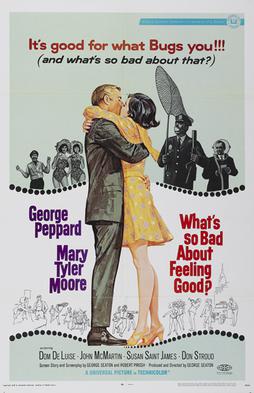
Cast
The movie is notable for its ensemble cast, which includes several familiar faces of 1960s American cinema and television:
Themes and style
The film blends broad comedy and social satire. Its central idea—that happiness might spread like an infection and that official institutions may try to suppress it—allows the screenplay to poke fun at bureaucracy, commercial interests, and public order. The tone is generally genial rather than bitter, relying on character interactions and situational humor rather than hard-edged critique.
Reception and context
Upon release the film did not meet box-office expectations and received mixed notices from critics, some of whom praised the performances while others found the premise thin. The late 1960s context—an era of social change and experiments in popular culture—helped frame audience responses; viewers familiar with the stars' previous work often noted the charming rather than challenging nature of this comedy.
Legacy and notable facts
Today What's So Bad About Feeling Good? is often recalled as a minor, curious entry in the careers of its principal players and its director. It is sometimes mentioned in discussions of Hollywood comedies that used high-concept premises to explore social norms. While never a major commercial or critical success, it retains interest for fans of 1960s light satire and the cast's performances, and it occasionally appears in retrospectives and home-video releases.
Author
AlegsaOnline.com What's So Bad About Feeling Good? (1968 film) Leandro Alegsa
URL: https://en.alegsaonline.com/art/147729