
Waldo R. Tobler: Geographer, Cartographer, and Pioneer of Spatial Analysis
American geographer and cartographer best known for Tobler's First Law of Geography; influential in computational cartography, spatial modeling, pycnophylactic interpolation, and the hiking function.
Waldo R. Tobler (1930–2018) was an influential American geographer and cartographer whose work shaped modern spatial analysis and geographic information science. Born in Portland, Oregon, Tobler spent his career developing mathematical and computational approaches to represent, interpolate, and model geographic phenomena. He remained an active Professor Emeritus in the Department of Geography at the University of California, Santa Barbara until his death in Santa Barbara, California in February 2018.
Image gallery
10 Images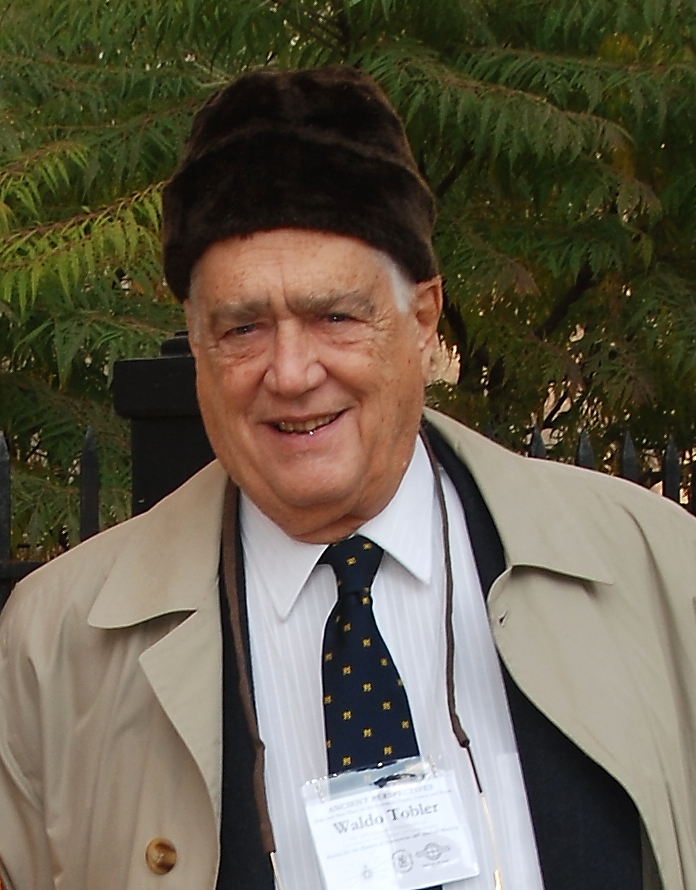



Key ideas and the "laws" of geography
Tobler is best known for formulating what became known as the First Law of Geography: "Everything is related to everything else, but near things are more related than distant things." This succinct statement highlights spatial dependence and underlies many methods in spatial statistics and geographic modeling. He later proposed a second, related aphorism: that phenomena outside an area of interest influence what occurs inside it. Both ideas emphasize the importance of spatial context, and they are often invoked when designing models, choosing neighbourhood definitions, or interpreting spatial patterns.
Major contributions and concepts
- Pycnophylactic interpolation — Tobler developed a mass-preserving technique for converting aggregated areal data (such as population counts by administrative unit) into smooth surface representations while conserving totals across regions. This approach is still cited in spatial data processing.
- Tobler's hiking function — He proposed an empirical formula to estimate walking speed as a function of slope, useful in accessibility studies, least-cost path calculations, and outdoor recreation models.
- Computational and analytical cartography — Tobler was an early adopter of computers for map design and spatial analysis, contributing to the transition from manual cartography to computerized geographic information systems.
- Spatial modeling and autocorrelation — Through both theoretical work and practical methods, Tobler influenced how geographers account for spatial dependence when modeling processes ranging from urban growth to environmental patterns.
These contributions are practical as well as theoretical: they provide tools for converting discrete counts into continuous surfaces, estimating movement across terrain, and building models that respect the spatial structure of geographic data. Many techniques that underpin contemporary GIS and spatial statistics can be traced to problems Tobler helped formalize.
Career, influence, and legacy
Tobler's career combined teaching, research, and method development. He supervised students, published widely on methods of representation and analysis, and influenced disciplines that rely on spatial thinking, including economics, planning, ecology, and transportation. His First Law remains a foundational heuristic taught in geography courses and cited in applied research; the pycnophylactic method and hiking function continue to appear in applied GIS workflows.
Though famously concise, Tobler's statements and methods encouraged geographers to make spatial assumptions explicit and to develop quantitative tools that respect those assumptions. His work helped establish a bridge between theoretical geography and computational practice, leaving a lasting imprint on how spatial data are processed and interpreted.
Author
AlegsaOnline.com Waldo R. Tobler: Geographer, Cartographer, and Pioneer of Spatial Analysis Leandro Alegsa
URL: https://en.alegsaonline.com/art/147393