
The Russians Are Coming, the Russians Are Coming (1966)
1966 American comic satire directed by Norman Jewison about a Soviet submarine stranded near a New England island; ensemble cast, Cold War themes, and four Academy Award nominations.
The Russians Are Coming, the Russians Are Coming is a 1966 American comedy film directed by Norman Jewison and adapted from Nathaniel Benchley’s 1961 novel The Off-Islanders. The film blends farce with social observation: after a Soviet submarine runs aground near a small New England community, a series of misunderstandings and panicked responses lead to both comic situations and moments of unexpected empathy.
Image gallery
3 Images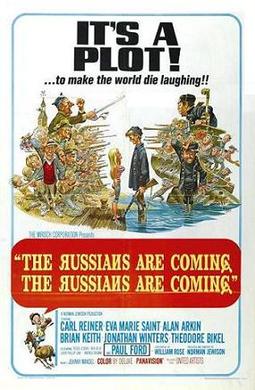


Plot
The story follows a handful of Soviet sailors who must make their way ashore and avoid capture while island residents — from officials to ordinary families — react with alarm. Mistaken identities, rumors, and escalating defensive measures create much of the humor, while the sailors’ efforts to survive without provoking violence expose the human side of people on opposite sides of a geopolitical divide. The unresolved tension between local fear and private kindness drives the narrative toward conciliatory scenes rather than violent confrontation.
Cast and characters
The ensemble cast mixes established dramatic actors and well-known comedians. The film features Alan Arkin, whose performance helped define the film’s balance of satire and sympathy; Carl Reiner, who contributes comic timing; Eva Marie Saint as a key civilian presence; and Brian Keith, who portrays local authority. Comic performers such as Jonathan Winters and supporting actors like Theodore Bikel and others add improvisatory energy. Other credited players include Paul Ford and Michael J. Pollard.
Production and release
The film was distributed by United Artists. Its production emphasized character scenes and community interactions over large-scale spectacle, using a compact setting to stage escalating misunderstandings. Released in the mid-1960s, the picture arrived at a moment when Cold War anxieties were prominent in public life; the filmmakers chose a comic, humane approach rather than political polemic.
Themes and style
The film combines screwball elements and situational comedy with a clear social sensibility. It satirizes paranoia, military posturing, and xenophobia while insisting on common humanity. Visual humor, timing, and the ensemble’s interplay are employed to undercut fear and to show how ordinary people can respond with decency even when institutions fail to do so.
Reception and legacy
Contemporary reviewers praised the film’s wit and performances, and it received recognition during awards season with four Academy Award nominations. Over time it has been regarded as an example of Cold War-era satire that favored reconciliation over caricature. Film historians and critics often cite it for its humane tone and ensemble craftsmanship.
Viewing today
Modern audiences may find the film reflective of its era in style and sensibility, yet its central message—that shared humanity can overcome fear driven by politics—remains accessible. The movie is frequently discussed in surveys of 1960s American comedies and Cold War cinema for its attempt to combine humor with a plea for understanding.
Author
AlegsaOnline.com The Russians Are Coming, the Russians Are Coming (1966) Leandro Alegsa
URL: https://en.alegsaonline.com/art/146671