
Tender Is the Night (1962 film)
1962 American drama directed by Henry King, adapted from F. Scott Fitzgerald's novel; stars Jennifer Jones and Jason Robards and dramatizes a glamorous marriage's unraveling.
Overview
Tender Is the Night is a 1962 American drama film directed by Henry King, adapted from the 1934 novel by F. Scott Fitzgerald. The movie focuses on the rise and decline of a glamorous American couple on the European social scene and treats themes of love, ambition, mental illness and personal disintegration against a backdrop of expatriate life.
Image gallery
1 Image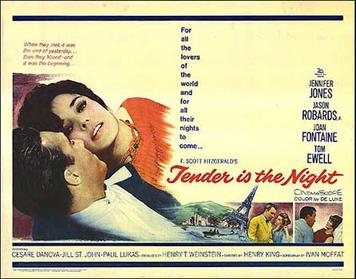
Cast and principal characters
The leading roles are played by Jennifer Jones and Jason Robards, who portray the film's central couple. The cast also includes actors such as Joan Fontaine, Tom Ewell and Cesare Danova. Performances were often remarked upon as one of the film's strengths, with attention given to how the actors convey complicated private struggles beneath a polished public image.
Adaptation and production
The film was produced at a time when major studios sought to translate literary works for mainstream audiences, and it was distributed by 20th Century Fox. The screenplay compresses Fitzgerald's layered narrative into a conventional feature format, which required streamlining episodes and combining or omitting some secondary characters. The result is a film that emphasizes the melodrama and romantic aspects of the source material while simplifying some of the novel's psychological and social nuances.
Reception and historical context
On release, the movie received mixed reviews: critics and viewers praised aspects such as its period atmosphere and lead performances but often noted the difficulty of rendering the novel's interior complexity on screen. Over time the film has been discussed more as a period studio attempt to bring a modernist American novel to cinema audiences than as a definitive cinematic recreation of Fitzgerald's work.
Notable differences from the novel
- Condensation of plot: the film shortens or omits certain episodes to fit a standard runtime.
- Simplified character arcs: some characters are given less backstory and fewer psychological layers.
- Altered emphasis: cinematic choices shift attention toward romance and melodrama over the novel's social critique.
- Visual interpretation: the film translates internal states into visual and performance cues rather than Fitzgerald's prose style.
Legacy and where to learn more
While generally less influential than Fitzgerald's book, the 1962 film remains of interest to students of literary adaptations and studio-era filmmaking. For background on the original novel see F. Scott Fitzgerald's work, and for details about the performers consult profiles of Jennifer Jones, Jason Robards and Joan Fontaine. The film is most often studied in discussions about the challenges of adapting complex modernist fiction for mid-20th-century cinema.
Author
AlegsaOnline.com Tender Is the Night (1962 film) Leandro Alegsa
URL: https://en.alegsaonline.com/art/146500