
Mister Cory (1957 film)
1957 American crime drama directed by Blake Edwards, starring Tony Curtis and Martha Hyer; a character-driven study of ambition, class and moral compromise in studio-era cinema.
Overview
Mister Cory is a 1957 American crime drama distributed by Universal Pictures. Directed by Blake Edwards, the film centers on a young man named Cory and his attempts to rise in society. The picture is notable for its emphasis on character and social detail rather than action, and for featuring Tony Curtis during a busy period of his career.
Image gallery
1 Image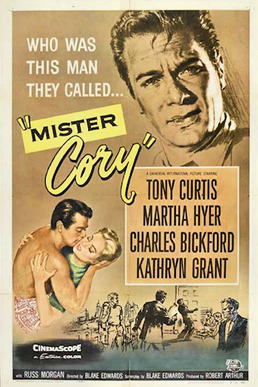
Plot and themes
The story follows Cory, an ambitious young man who seeks to escape his modest origins by entering new social circles. The film explores ambition, romance, and the ethical compromises made in pursuit of status and security. Rather than presenting a conventional crime thriller, the film treats criminal elements as catalysts for character development and moral choice.
Cast and characters
- Tony Curtis plays the title role, bringing charm and restlessness to the part.
- Martha Hyer appears as the film's principal romantic interest and social foil.
- Charles Bickford, Henry Daniell and Kathryn Grant fill supporting roles that represent older, established figures Cory must navigate.
- William Reynolds and other credited players round out the cast, contributing to the film's study of status and relationships.
Production and style
Made within the studio system of the 1950s, the film reflects restrained storytelling and a focus on performance. It belongs to Blake Edwards's earlier, more serious phase, preceding the popular comedies for which he later became widely known. Production values and cinematography serve the narrative's intimate tone, supporting the film's concern with social nuance rather than spectacle.
Reception and legacy
Upon release, the film attracted attention for its lead performance and for Edwards's direction. Critics and later viewers have regarded it as a compact example of postwar American drama that examines social mobility and moral ambiguity. While not as prominent as some contemporaneous studio pictures, it remains of interest to students of midcentury cinema and the careers of its principal artists.
Home media and study
Over time the title has circulated through theatrical retrospectives and home media releases, often packaged within the broader filmographies of its director and stars. Film scholars note its value as a character study and as an illustration of how 1950s Hollywood could address questions of class and ambition within the constraints of studio production.
Further reading
For more information on the film and its creators, consult retrospective essays on Blake Edwards, biographies of Tony Curtis, and studio histories that discuss Universal Pictures and midcentury American cinema. Archival resources and curated film programs may provide additional context for contemporary viewers.
Author
AlegsaOnline.com Mister Cory (1957 film) Leandro Alegsa
URL: https://en.alegsaonline.com/art/142778