
King Kong (1933 film)
1933 black-and-white American adventure–fantasy–horror film directed by Merian C. Cooper and Ernest B. Schoedsack, noted for pioneering stop-motion effects and preserved in the U.S. National Film Registry.
Overview
King Kong is a 1933 black-and-white American adventure–fantasy–horror film and the original entry in what became a long-running franchise first released in 1933. It was produced and co-directed by Merian C. Cooper and Ernest B. Schoedsack, and it stars Fay Wray, Bruce Cabot, and Robert Armstrong. The story follows an expedition to a remote island where a colossal ape dubbed Kong is discovered, captured, and transported to New York City, with catastrophic consequences. The picture combined spectacle, romance, and horror to create a new kind of large-scale cinematic entertainment.
Image gallery
10 Images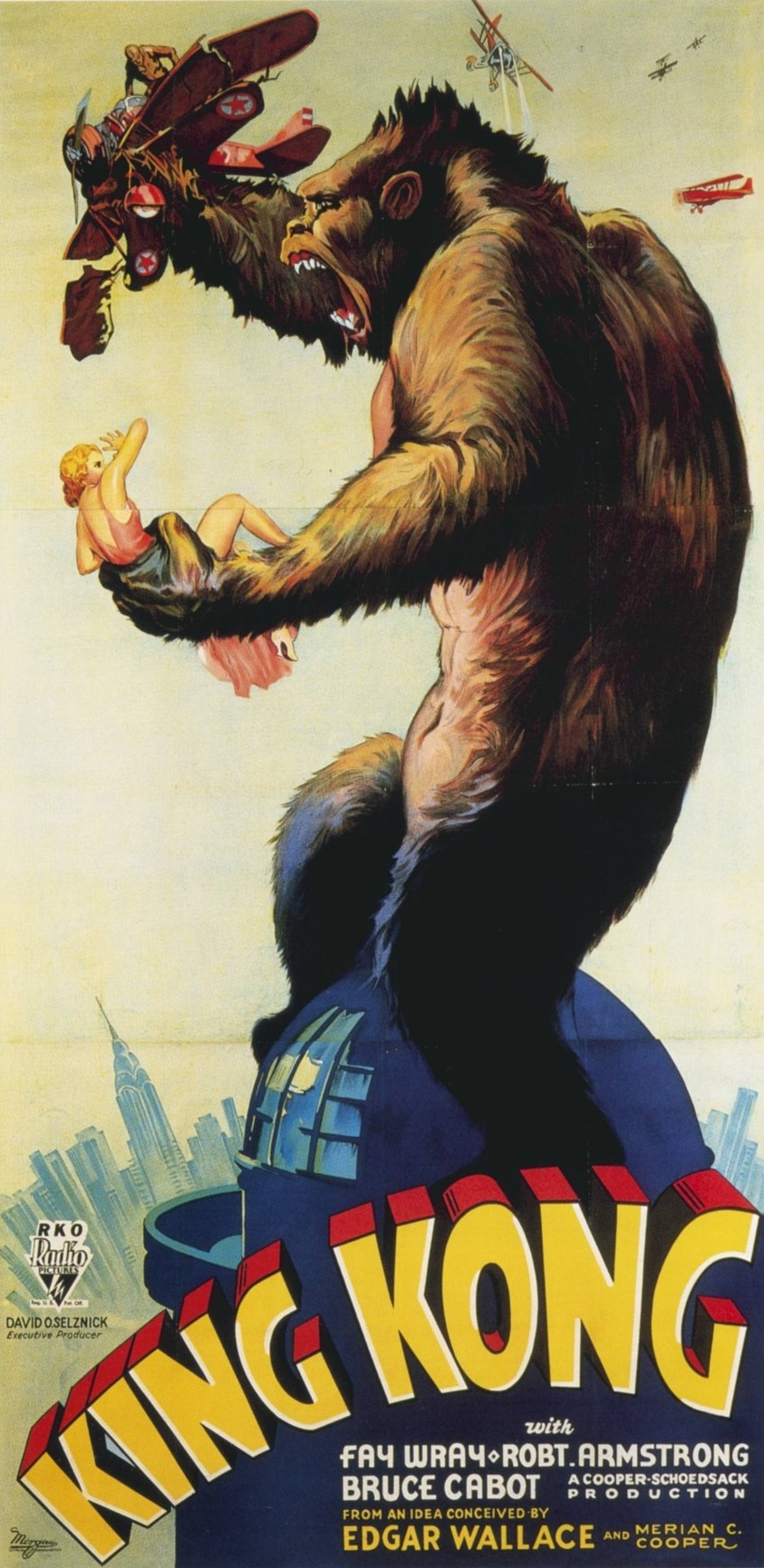


Production and principal contributors
The screenplay was crafted by Ruth Rose and James Ashmore Creelman, adapting a story by Merian C. Cooper (with credited contributions traced to Edgar Wallace) and a popular novelization by Delos W. Lovelace. The film’s score was composed by Max Steiner, whose music helped establish early conventions for dramatic film scoring (Max Steiner). Cooper’s personal vision and the film’s ambitious showmanship are central to its lasting reputation (Merian C. Cooper).
Special effects and technical achievements
King Kong is widely remembered for its groundbreaking visual effects. The creature was brought to life largely through stop-motion animation, a painstaking frame-by-frame technique that allowed models to move convincingly against miniature sets. The stop-motion work was supervised by and built on the innovations of Willis O'Brien, whose models and animation sequences established methods followed by later special-effects artists. The production also used rear-projection, matte paintings, scaled sets and composite photography to integrate actors and models into the same scenes.
Plot elements and themes
At its simplest, the plot traces an expedition to a mysterious island, the capture of a magnificent but deadly animal, and its exhibition in an urban setting where nature clashes with civilization. The film blends thrills and pathos, often read as a modern "beauty and the beast" tale: the relationship between the human heroine and Kong carries emotional weight even as the creature becomes a symbol of untamed nature and tragic misplacement. Critics and scholars have also discussed secondary themes such as spectacle, the ethics of exploitation, and the technological display of film itself.
Release, reception, and preservation
King Kong opened in March 1933 and drew praise for its imagination and technical accomplishment, becoming an influential box-office success of its era. Over time it has been reappraised as a landmark of early special effects and genre filmmaking. In 1991 the film was recognized by the Library of Congress and selected for preservation in the National Film Registry as culturally, historically, or aesthetically significant (Library of Congress / National Film Registry).
Legacy, remakes, and notable facts
The film spawned sequels, imitations, and remakes (notably in 1976 and 2005) and established many conventions of monster cinema. Its influence is apparent in later creature features, visual-effects practice, and popular culture more broadly. Key elements often highlighted by historians include:
- Innovations in stop-motion and model-based effects (stop-motion and Willis O'Brien).
- Early use of a full dramatic score to support on-screen action (Max Steiner).
- The blend of melodrama, horror, and adventure that helped define Hollywood genre mixing (Cooper).
- Enduring status as a cultural icon recognized by preservation efforts (National Film Registry).
King Kong remains both a product of its time and a milestone in cinematic storytelling and effects, studied by filmmakers and scholars and enjoyed by audiences as a defining example of early 20th-century popular cinema.
Questions and answers
Q: What year was the original King Kong movie released?
A: The original King Kong movie was released in 1933.
Q: Who directed and produced the film?
A: The film was directed and produced by Merian C. Cooper and Ernest B. Schoedsack.
Q: Who wrote the screenplay for the movie?
A: The screenplay was written by Ruth Rose and James Ashmore Creelman.
Q: Who wrote the story that inspired the script?
A: The story that inspired the script was written by Cooper and Edgar Wallace, as well as a novel by Delos Lovelace.
Q: What is King Kong famous for?
A: King Kong is famous for its stop-motion animation by Willis O'Brien.
A:The music for King Kong was written by Max Steiner.
Q:Who composed the music for King Kong?
Q:What year did it get selected to be preserved in National Film Registry ?
A:King Kong got selected to be preserved in National Film Registry in 1991.
Author
AlegsaOnline.com King Kong (1933 film) Leandro Alegsa
URL: https://en.alegsaonline.com/art/140933