
Darling (1965 film)
Darling (1965) is a British romantic drama directed by John Schlesinger, starring Julie Christie and Dirk Bogarde. The film explores 1960s celebrity culture and social change; it received five Oscar nominations and won two.
Overview
Darling is a 1965 British romantic drama directed by John Schlesinger that captures aspects of Swinging London and shifting social values of the 1960s. Combining intimate character study with sharp social observation, the film follows the rise and personal costs of a young woman who becomes a celebrated public figure. It was distributed by Embassy Pictures and attracted both commercial attention and critical debate on fame, morality, and modern relationships.
Image gallery
1 Image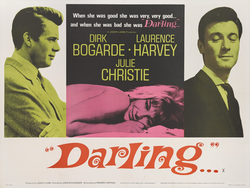
Plot and themes
The central narrative charts the life of an ambitious and attractive woman whose charm opens doors in fashion, advertising and high society, yet leaves her emotionally unsettled. The story examines themes of identity, loneliness, the commodification of personality, and the clash between private longing and public image. Its tone moves between melodrama and satirical commentary, using the protagonist’s relationships to probe the era’s changing sexual and social mores.
Principal cast and crew
- Julie Christie — leading role
- Dirk Bogarde — key supporting role
- Laurence Harvey — prominent supporting part
- José Luis de Villalonga — supporting cast
- Pauline Yates — supporting cast
- Basil Henson, Roland Curram and others in ensemble roles
- John Schlesinger — director
- Umberto Raho — additional cast member
- Darling was released internationally and found a wide audience for its portrait of contemporary life.
Production, style and influences
Made during a period of rapid change in British cinema, the film reflects the influence of contemporary social realism while adopting a stylish, modernist visual language. Location work in London, chic interiors, and fashion-conscious costume design anchor the movie in its decade. The director’s approach blends psychological focus with observational detail, and the narrative pacing alternates intimate scenes with wider social set pieces.
Reception and awards
Critics praised the performances and the film’s timely subject matter, though some reviews debated its moral perspective. It attracted significant awards attention: the movie earned multiple Academy Award nominations and won two Oscars at the 1966 ceremony. Over time it has been discussed both as a snapshot of 1960s popular culture and as a character-driven drama that interrogates fame and selfhood.
Legacy and distinctions
Darling is often cited in discussions of British cinema of the 1960s for its depiction of celebrity and urban life. Its lead performance and director’s reputation helped cement the film’s place in film histories of the period. For further reading on the film’s context and creative team, see contemporary reviews and retrospective studies linked from film reference sites and archives: cast and credits and curated collections of 1960s British films online.
Author
AlegsaOnline.com Darling (1965 film) Leandro Alegsa
URL: https://en.alegsaonline.com/art/137270