
Cherokee language: overview, writing system, history, and revitalization
Cherokee (Tsalagi) is an Iroquoian language of the Cherokee people, known for Sequoyah’s syllabary. It faces decline but has active revitalization through schools, media, and community programs.
Overview
The Cherokee language (Tsalagi Gawonihisdi) is an Iroquoian tongue traditionally spoken by the Cherokee people. Once widely used across parts of the southeastern United States, the language experienced decline after displacement and cultural disruption. Today it is considered endangered, and documentation and teaching efforts aim to sustain and expand its use. For current status and resources see language resources.
Image gallery
10 Images



Writing system and linguistic features
Cherokee is notable for its syllabary, a set of written characters that represent syllables rather than individual phonemes. This syllabary is encoded in Unicode and is used in print, signage, and digital media. Linguistically, Cherokee displays polysynthetic morphology: words—especially verbs—can combine many elements to convey what in other languages would require a phrase or sentence.
Dialects and distribution
There are two principal contemporary dialect groups commonly described as Eastern (spoken in North Carolina) and Western (spoken in Oklahoma). Dialectal differences affect pronunciation and some vocabulary but remain mutually intelligible to a large extent. Speaker communities include enrolled tribal members, elders, classroom learners, and language activists.
History and development
In the early 19th century Sequoyah (also called George Gist) devised the Cherokee syllabary, an innovation that greatly increased literacy in the language. The syllabary allowed the Cherokee to publish newspapers, record law and history, and retain cultural knowledge in written form. Over subsequent centuries, social pressures and federal policies reduced everyday use, prompting modern recovery efforts.
Uses, revitalization and education
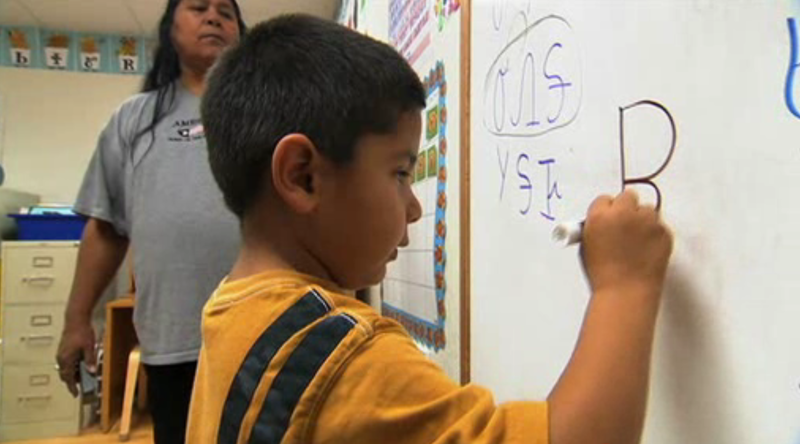
Contemporary revitalization strategies include immersion schools, community classes, teacher training, radio broadcasts, dictionaries, and digital tools. Tribal governments and language organizations collaborate to develop curricula, train educators, and produce media in Cherokee to encourage intergenerational transmission.
Notable distinctions
- Unique script: The Cherokee syllabary is one of the few scripts in North America developed specifically for an indigenous language and is widely credited to a single inventor.
- Cultural importance: Language is central to ceremonies, oral history and identity for Cherokee communities.
- Modern support: Unicode inclusion and contemporary technology have eased digital use and preservation.
Author
AlegsaOnline.com Cherokee language: overview, writing system, history, and revitalization Leandro Alegsa
URL: https://en.alegsaonline.com/art/136439