
Casey's Shadow (1978 film)
A 1978 American drama about horse racing and family, directed by Martin Ritt and starring Walter Matthau; adapted from a John McPhee story and released by Columbia Pictures.
Casey's Shadow is a 1978 American drama that examines the world of Thoroughbred racing through a family-centered story. Directed by Martin Ritt, the film adapts a short piece by writer John McPhee into a character-driven narrative focused on ambition, loyalty, and the messy ethics of small-time sport. It is notable for its naturalistic tone and for blending elements of a family drama with the specifics of racetrack culture.
Image gallery
1 Image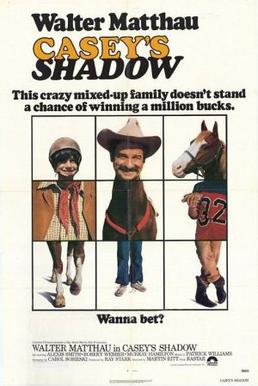
Cast and principal roles
- Walter Matthau — leading role, whose measured performance anchors the film; see actor page at Walter Matthau.
- Alexis Smith — co-star who contributes to the film's domestic and moral stakes.
- Murray Hamilton — supporting role; listed at Murray Hamilton.
- Robert Webber — plays a significant part in the racing subplot; reference Robert Webber.
- Andrew Rubin — a younger cast member who helps convey the film's intergenerational themes.
Production and source material
The screenplay draws on John McPhee's reportage-style writing to render the technical side of horse racing alongside intimate character moments. Director Martin Ritt was known for socially aware dramas, and his approach here emphasizes authenticity: racetrack routines, training details, and the pressures faced by small stables. Columbia Pictures handled distribution, giving the film a mainstream release through Columbia Pictures.
Themes, reception, and legacy
Critics often highlighted the performances and the film's respectful, unsensational look at a niche sporting milieu. Major themes include ambition tempered by conscience, the bond between humans and animals, and the compromises required to succeed in a tight-knit but competitive world. While not a blockbuster, the film has retained interest among fans of racing stories and 1970s American dramas.
For readers exploring American cinema of the era, Casey's Shadow stands as an example of a modestly scaled film that prioritizes character and setting over spectacle. It remains referenced in discussions of films that sympathetically portray working-class pursuits and the ethical questions they raise.
Author
AlegsaOnline.com Casey's Shadow (1978 film) Leandro Alegsa
URL: https://en.alegsaonline.com/art/136210