
Brachial artery
Major artery of the upper arm; continuation of the axillary artery that supplies the arm and elbow, palpated in the cubital fossa and used for blood pressure measurement and clinical access.
Overview
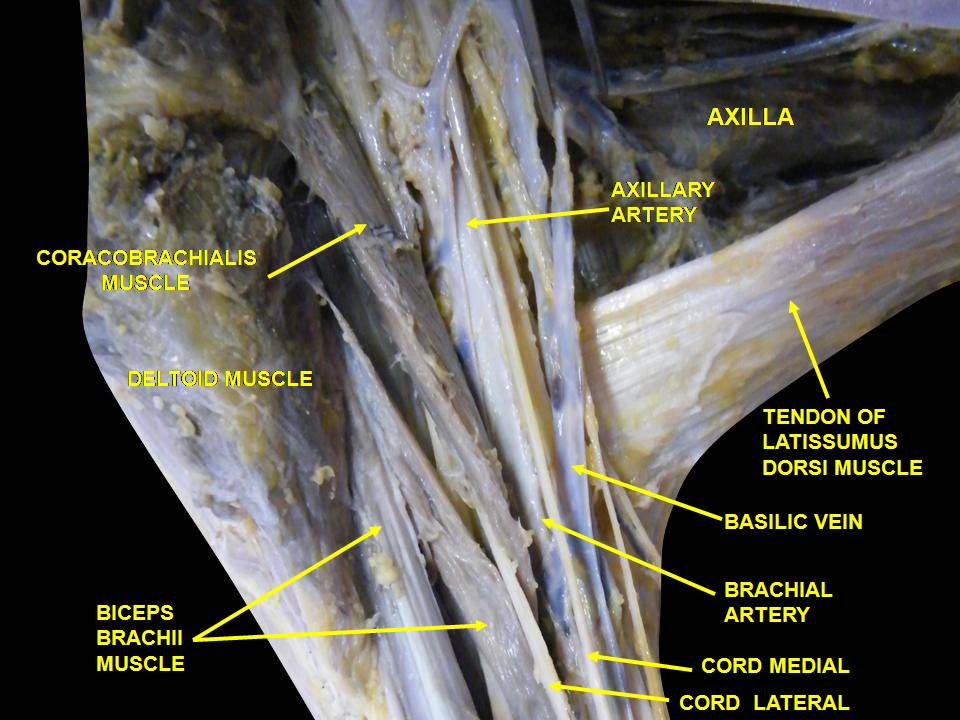
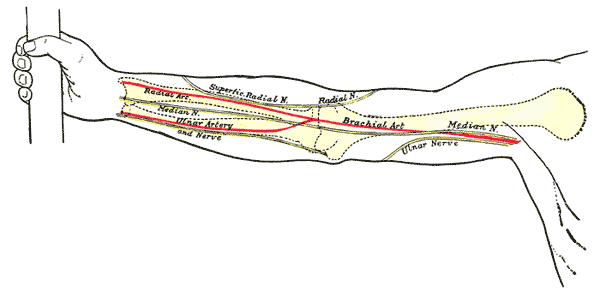
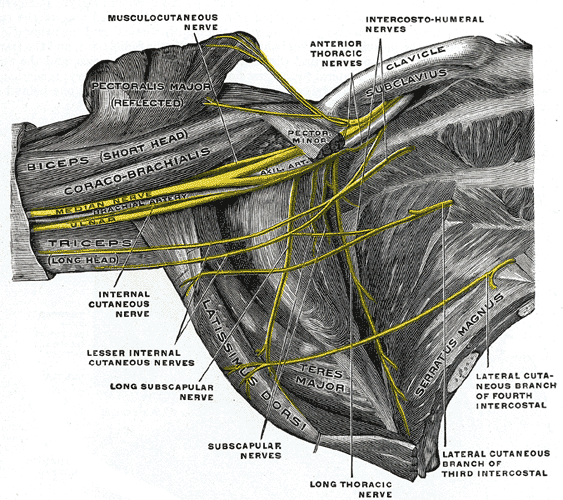
The brachial artery is the principal artery of the upper arm. It continues from the axillary artery at the lower border of the teres major, travels down the medial aspect of the arm and usually divides in the cubital fossa into the radial and ulnar arteries. It delivers oxygenated blood to muscles and joints of the arm and to structures around the elbow.
Image gallery
10 Images





Anatomy and branches
The brachial artery runs with the median nerve and is overlain by the biceps brachii tendon near the elbow. Major branches commonly include:
- Profunda brachii (deep brachial) — supplies posterior arm muscles
- Superior and inferior ulnar collaterals — contribute to the arterial network around the elbow
- Muscular branches — small arteries to surrounding tissues
Function and clinical importance
Functionally, the brachial artery supplies the anterior and posterior compartments of the arm and participates in collateral circulation of the elbow. Clinically it is the target for common procedures: noninvasive blood pressure measurement with a cuff is standardized over the brachial artery, and the pulse can be palpated in the cubital fossa, medial to the biceps tendon. It is also a consideration in trauma, surgical exposure, and vascular access.
Clinical considerations and variations
Injury to the brachial artery can cause significant bleeding or distal ischaemia; supracondylar humeral fractures in children are a known risk for vascular compromise. Anatomical variations occur, such as a high bifurcation into radial and ulnar arteries or variant branching patterns, which are important for surgeons and interventionalists to recognize. Arterial cannulation and sampling more commonly use distal vessels, but the brachial artery remains important for hemostasis and diagnostic palpation.
Historical and developmental notes
The vessel is described in classical anatomical texts as the continuation of the axillary artery. During development the arterial pattern of the limb forms from a primary axial artery with subsequent remodeling; this process explains the range of observed adult variations. Understanding brachial artery anatomy is fundamental for safe clinical practice in orthopedics, vascular surgery and emergency medicine.
Tags
Related articles
Author
AlegsaOnline.com Brachial artery Leandro Alegsa
URL: https://en.alegsaonline.com/art/13571