
Borys Paton, Ukrainian scientist and longtime head of the National Academy of Sciences
Borys Yevhenovych Paton (1918–2020) was a Ukrainian engineer and researcher in electric welding who led the National Academy of Sciences of Ukraine from 1962 until 2020.

Overview
Borys Yevhenovych Paton (27 November 1918 – 19 August 2020) was a Ukrainian engineer and scientist best known for his work on electric welding and for leading the National Academy of Sciences of Ukraine for decades. He was born in Kyiv and became a central figure in Ukrainian and Soviet-era applied science, combining laboratory research with industrial implementation and institutional leadership. His Ukrainian name is recorded as Пато́н Бори́с Євге́нович.
Image gallery
2 Images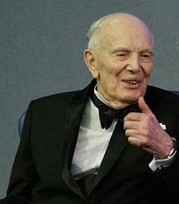

Scientific contributions
Paton specialized in welding technologies, metallurgy and the development of automated and electrical methods for joining metals. His work advanced the reliability and scale of welded structures used in industry, transportation and infrastructure. He promoted the integration of theoretical research with practical engineering, helping transfer scientific developments into production techniques.
Leadership and development
Appointed chairman of the National Academy of Sciences of Ukraine in 1962, Paton directed the institution through a period that spanned the late Soviet era and the independence of Ukraine. Under his leadership, the Academy emphasized applied research, coordination among laboratories, and international scientific contacts. He served in that role for many years, making him one of the longest-serving heads of a national academy in modern times.
Impact and applications
Paton's research influenced a wide range of industries where strong, reliable metal joints are critical: shipbuilding, bridge construction, power engineering and heavy machinery. His emphasis on electrical welding techniques contributed to safer, more efficient manufacturing processes and supported modernization efforts in post-war industry.
Notable facts
- He was born and died in Kyiv, living to the age of 101.
- He came from a family with an engineering background and became a prominent scientific administrator as well as a researcher.
- Paton received many national and international honors for his scientific and organizational work and is remembered for bridging laboratory science and industrial practice.
Paton's legacy endures in modern welding technology and in the institutions he helped shape, which continue to support research and technological development in Ukraine and beyond.
Author
AlegsaOnline.com Borys Paton, Ukrainian scientist and longtime head of the National Academy of Sciences Leandro Alegsa
URL: https://en.alegsaonline.com/art/135522