
All Dogs Go to Heaven (1989) — Don Bluth animated fantasy about redemption and friendship
Don Bluth's 1989 animated fantasy follows a roguish dog who returns from the afterlife and forms an unlikely bond with an orphan, exploring themes of redemption, friendship and emotional growth.
All Dogs Go to Heaven is a 1989 animated fantasy film directed by Don Bluth. The story follows a roguish dog who, after an encounter with death, returns to the world of the living and forms an unexpected bond with a young orphan. The movie features leading voice performances by Burt Reynolds and Dom DeLuise.
Image gallery
1 Image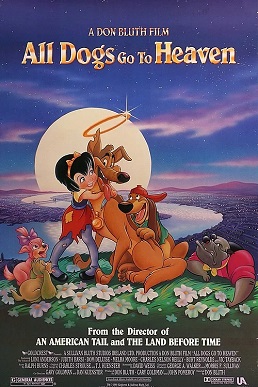
Overview
The film blends elements of comedy, drama and fantasy to explore themes of redemption, friendship and the afterlife. Although aimed in part at family audiences, its tone shifts between lighthearted sequences and darker moments, a contrast that shaped both its critical reception and its later reputation.
Plot summary
At the center of the film is a smooth-talking dog whose carefree life is interrupted by tragedy. After dying and experiencing the afterlife, he finds a way back and becomes involved with a lonely young girl. Through their relationship he faces moral choices that lead him toward a different view of himself. The narrative mixes adventure set-pieces with quieter scenes that develop the characters' emotional arcs.
Production
The picture was produced by the animation company founded by its director, who had previously worked for major animation studios. The film employs traditional hand-drawn animation and includes several musical numbers that punctuate key moments. The cast combines established screen actors with voice performers and a child actor in a prominent role.
Release and reception
Upon release the film received mixed reviews: many critics praised the animation quality and some vocal performances, while others found the tonal shifts uneven. It did not immediately become a mainstream critical favorite but found a wider audience through home video and television broadcasts, developing a devoted following over time.
Legacy
- A follow-up feature and an animated television series were produced in the years after the original film, expanding the story for younger viewers and further popularizing the characters.
- The film remains notable in the director's body of work for its distinctive visual style and for tackling more mature emotional themes than are typical in many family animated releases.
Author
AlegsaOnline.com All Dogs Go to Heaven (1989) — Don Bluth animated fantasy about redemption and friendship Leandro Alegsa
URL: https://en.alegsaonline.com/art/134340