
201 BC — Formal end of the Second Punic War and developments in the ancient world
201 BC saw the formal conclusion of the Second Punic War with Rome imposing peace on Carthage, growing Roman influence, and political consolidation in other regions such as the early Han dynasty in China.
201 BC is traditionally remembered as the year in which the protracted conflict between Rome and Carthage was formally closed and the balance of power in the western Mediterranean shifted decisively toward Rome. In Roman chronological practice this year fell under the pre-Julian system; contemporary Roman writers would have named the year by its consuls rather than by a numerical era (pre-Julian Roman calendar).
Image gallery
1 Image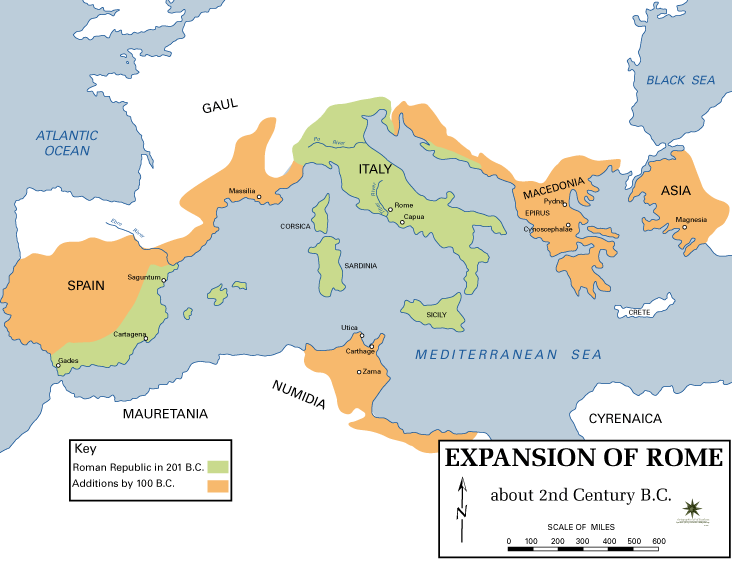
Major events
The most consequential development was the conclusion of peace between Rome and Carthage. After years of campaigning that culminated in the defeat of Hannibal and the Roman victory at Zama the previous year, negotiators drew up terms that curtailed Carthage's military power and overseas ambitions, handed effective control of former Carthaginian possessions in Spain to Rome, and required Carthage to pay a substantial indemnity. The settlement ended the Second Punic War and marked a turning point in Roman expansion.
In Rome itself, victorious generals and statesmen enjoyed renewed prestige. The outcome strengthened the Republic's influence across the western Mediterranean and set patterns of diplomacy and dominance that would shape the next centuries.
Other regions
Beyond the Mediterranean, 201 BC was a year of consolidation and transition in several polities. In the Hellenistic world, the successor kingdoms to Alexander's empire continued to jockey for territory and influence; Rome’s emergence as a major western power began to affect eastern rulers' calculations. In East Asia, the early Han dynasty, founded only a short time before, continued to consolidate central authority after the fall of the Qin and the end of the civil conflict that followed. Local administrations were being reorganized and former rivals were being absorbed into a renewed imperial framework.
Elsewhere, regional kingdoms and tribal groups maintained their own rhythms of conflict and diplomacy. The year did not mark a single global turning point beyond the Mediterranean, but it did contribute to trajectories—Roman hegemony in the west and imperial consolidation in China—that would have long-term consequences.
Significance and legacy
The diplomatic settlement of 201 BC illustrates how military victories were converted into lasting political arrangements. The terms imposed on Carthage limited its future capacity to challenge Rome and encouraged Roman engagement across the Mediterranean coasts. At the same time, developments in other regions show that the ancient world was interconnected by trade, migration and the diffusion of military and administrative ideas even where direct political control did not exist.
Notable figures associated with events around 201 BC include Roman commanders who supervised the peace and leading statesmen of the early Han. The year is often used by historians as a convenient marker separating the long struggle of the Second Punic War from the phase of Roman dominance that followed.
Author
AlegsaOnline.com 201 BC — Formal end of the Second Punic War and developments in the ancient world Leandro Alegsa
URL: https://en.alegsaonline.com/art/133768