
Valdivia Expedition (1898–1899): German Deep‑Sea Scientific Voyage
A German oceanographic expedition led by Carl Chun that circumnavigated major ocean basins in 1898–1899 to study deep‑sea life and physical oceanography; results issued in a 24‑volume series.
Overview
The Valdivia expedition was a pioneering German scientific voyage of deep‑sea exploration carried out between July 1898 and May 1899. Organised by the German scientific community and led by zoologist Carl Chun, the program aimed to investigate deep‑water fauna, oceanographic conditions and seafloor features at depths that had been little sampled to that time. The expedition is remembered for its extensive collections, systematic observations and a large multivolume publication that summarized its findings.
Image gallery
9 Images




Ship and equipment
To carry out the work, a commercial vessel was purchased from the Hamburg‑Amerikanische Packetfahrt‑Actien‑Gesellschaft and outfitted with scientific gear. The ship departed from Hamburg on 31 July 1898. On board were dredges, trawls and nets for sampling benthic and pelagic organisms, deep‑sea thermometers and sounding lines for bathymetry, and basic chemical and biological instruments for preserving and recording specimens. The combination of equipment allowed multidisciplinary study of both organisms and physical conditions.
Voyage and route
During a voyage of over 32,000 nautical miles, the expedition carried out investigations across several ocean basins. Teams took stations at deep locations in the Atlantic, Southern Ocean and portions of the Indian Ocean, and they sampled at a wide range of latitudes and depths. The ship returned to Hamburg on 1 May 1899 after roughly nine months at sea.
Scientific results
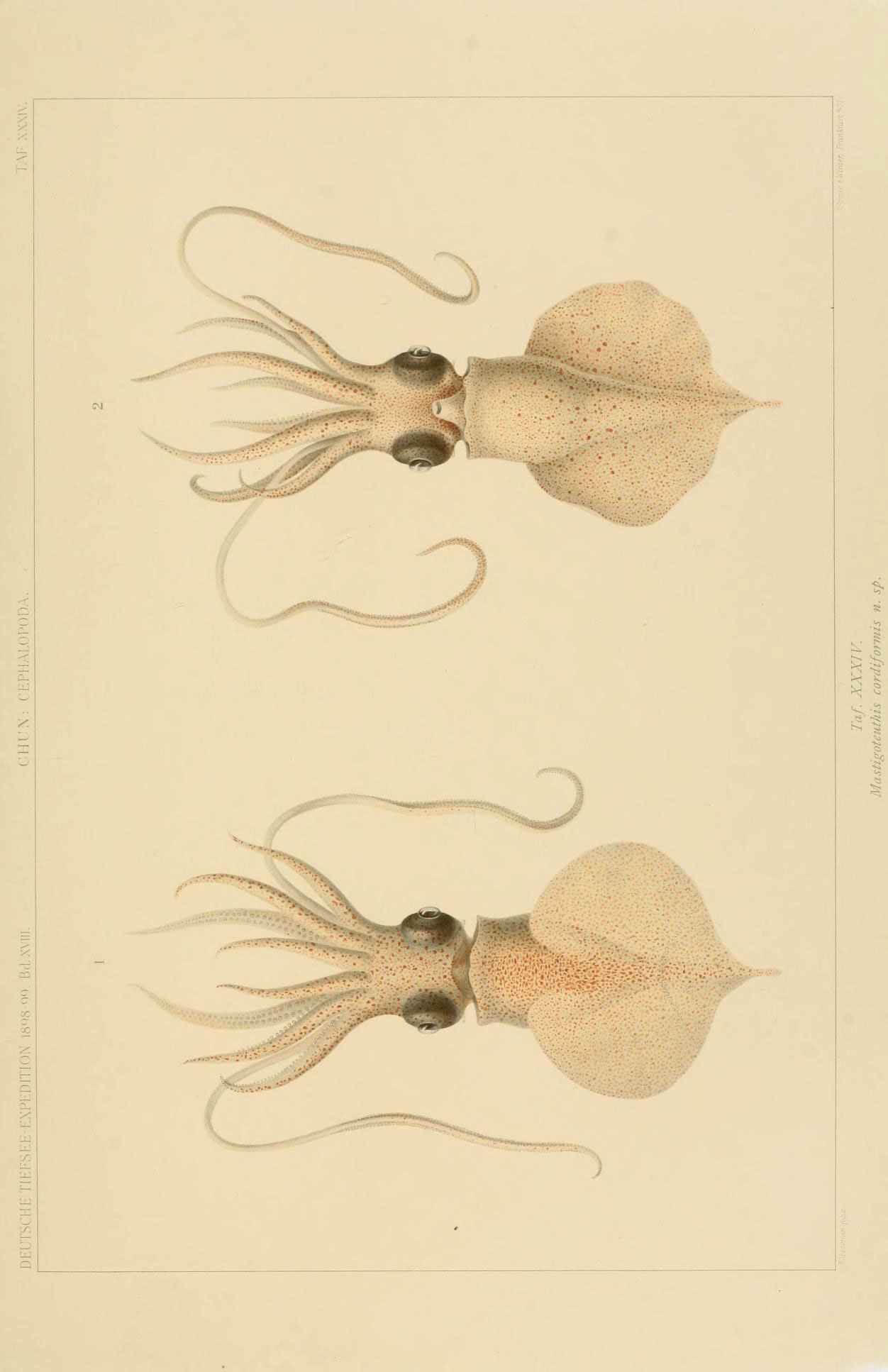
Researchers aboard collected large numbers of specimens, many of which proved to be new to science. The biological material included a diversity of invertebrates and fishes adapted to deep water, and particular attention was paid to cephalopods and other poorly known groups. Observations of temperature, salinity and depth contributed to early oceanographic knowledge. The expedition’s findings were consolidated in an extensive series of reports produced over decades.
Publication and legacy
The scientific results were published in a comprehensive 24‑volume series, a body of work that continued to appear into the 20th century and was not completed until 1940. The Valdivia expedition set a standard for systematic deep‑sea studies, provided important museum collections and taxonomic descriptions, and influenced later oceanographic and biological research by demonstrating the value of integrated, ship‑based sampling of the deep ocean.
Author
AlegsaOnline.com Valdivia Expedition (1898–1899): German Deep‑Sea Scientific Voyage Leandro Alegsa
URL: https://en.alegsaonline.com/art/132429