
Salvatore Riina — Sicilian Mafia boss (Totò 'u Curtu)
Salvatore "Totò" Riina (1930–2017) led the Corleonesi faction of Cosa Nostra. Noted for brutal tactics, the campaign of violence in the 1980s–90s, capture after decades as a fugitive, and long prison sentences.
Overview
Salvatore "Totò" Riina (16 November 1930 – 17 November 2017) was an Italian mob leader who rose to become the most feared figure in the Sicilian Mafia (Cosa Nostra) during the late 20th century. Born in the town of Corleone, Sicily, he became head of the Corleonesi, a faction that expanded its influence through a mix of brutality, strategic assassinations and ruthless elimination of rivals. Riina was widely known by the nickname Totò 'u Curtu, and the familiar form of his given name is shown by the diminutive Totò.
Image gallery
9 Images



Rise, methods and organization
Riina built power in the 1970s and 1980s by centralizing control and using extreme violence to intimidate opponents and state institutions. Under his direction the Corleonesi engaged in a campaign that targeted rival mafiosi, law-enforcement officials, magistrates and, at times, civilians. This strategy of terror included bombings and high-profile assassinations, intended both to remove obstacles and to destabilize the Italian state's response to organised crime.
- Leadership: elevated the Corleonesi to a dominant position within Cosa Nostra.
- Tactics: approval of indiscriminate violence, including attacks that affected non-combatants.
- Internal purge: removal or killing of rival bosses to consolidate authority.
Prosecutions, trials and capture
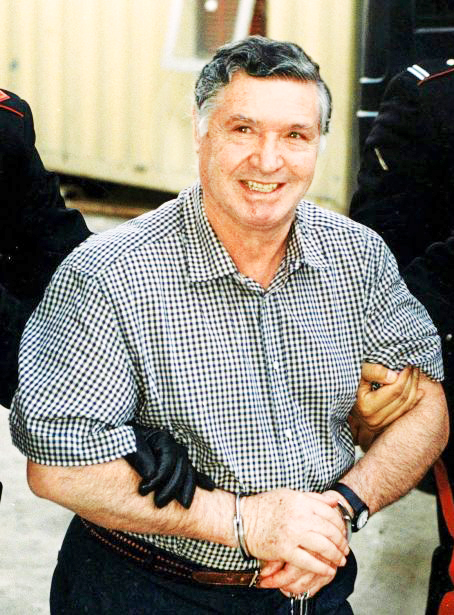
The activities of Riina and his circle drew major investigative and judicial attention in Italy. A large, sustained probe into Cosa Nostra produced mass trials that convicted many mafiosi and exposed the inner workings of the organization. Riina himself was tried and convicted in absentia on numerous counts, receiving multiple life sentences. After spending roughly two decades as a fugitive, he was arrested in the early 1990s; his capture marked a significant breakthrough for Italian law enforcement and led to further arrests and convictions among his collaborators.
Notable crimes and consequences
Riina is associated with the assassinations of prominent anti-mafia magistrates and other public figures. Two of the most widely publicized killings occurred in 1992 and involved judges who had played central roles in prosecuting Cosa Nostra; these murders provoked national outrage and strengthened public support for tougher measures against organised crime. Several former associates later testified about the scope of violence carried out on Riina's orders; for example, the mafioso Giovanni Brusca admitted to participating in numerous killings and estimated a very high number of victims linked to the campaign of terror.
Imprisonment, decline and death
Following his arrest, Riina was kept under the strict prison regime applied to top organised-crime figures. His imprisonment curtailed the overt, high-profile violence that had characterized his leadership, and other figures within Cosa Nostra shifted to lower-profile strategies. Riina remained a symbol of the most violent phase in modern Sicilian organised crime until his death. He died on 17 November 2017 in hospital in Parma; reports stated that complications including sepsis followed surgical treatment, and his death was widely reported and discussed in Italy and abroad. Parma hospital and sepsis were cited in coverage of his final days.
Legacy and notable facts
Riina's legacy is one of deep disruption: his years of leadership reshaped Cosa Nostra while provoking a sustained state response that included legal reforms, tougher prison conditions for mafia leaders and intensified investigations. His name remains associated with the most violent chapter of late 20th-century Italian organised crime. Scholars, journalists and prosecutors continue to study that period to understand how a criminal network could both wield brutal public violence and attempt to manipulate political and economic systems.
For further background on terminology and historical context see links to broader resources: Sicilian terms, Italian name forms, and general accounts of Riina's career and the prosecutions that followed. Additional overviews and documentary sources are available through specialized archives and legal records. Organised crime studies provide comparative perspective on methods and countermeasures, while contemporary reporting covered his arrest and trials in detail. Medical and prison reports were referenced in coverage of his final illness.
Author
AlegsaOnline.com Salvatore Riina — Sicilian Mafia boss (Totò 'u Curtu) Leandro Alegsa
URL: https://en.alegsaonline.com/art/130362