
Rodney Wilkes — Trinidad and Tobago Olympic Weightlifter
Rodney Wilkes (1925–2014) was a pioneering weightlifter from Trinidad and Tobago, nicknamed "The Mighty Midget", who won Olympic medals in 1948 and 1952 and inspired future Caribbean athletes.
Overview
Rodney Adolphus Wilkes (11 March 1925 – 24 March 2014) was a celebrated weightlifter from Trinidad and Tobago. Nicknamed "The Mighty Midget" for his comparatively small stature paired with exceptional strength, Wilkes became one of his country's earliest Olympic medallists. His international success in the immediate post‑war period brought attention to competitive weightlifting in the Caribbean and remains a notable chapter in the nation's sporting history.
Image gallery
2 Images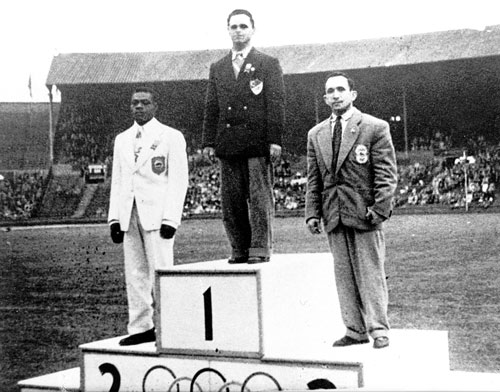

Career highlights
Wilkes achieved his most famous results at the Olympic Games. He won a silver medal at the 1948 London Games and followed that performance with a bronze medal at the 1952 Helsinki Olympics. He also took part in the 1956 Summer Olympics in Melbourne (1956 Olympics), representing his country on three consecutive Games and maintaining a high international profile for nearly a decade. His sport was weightlifting, and his breakthrough came at the 1948 London edition of the Games, the first Olympics held after World War II.
Style and significance
Competing in the lighter weight divisions, Wilkes was widely admired for demonstrating how technique, speed and determination could offset differences in size. His medals were important not only as individual achievements but also as milestones for Caribbean sport: they showed that athletes from small nations could reach the Olympic podium. For many younger competitors in the region he served as an inspiration and a proof of concept that international success was attainable.
Legacy and later life
After his competitive career, Wilkes's legacy endured in national sporting memory. His Olympic performances are regularly cited in accounts of Trinidad and Tobago's early presence at the Games. He died in 2014, and obituaries and commemorations highlighted both his athletic accomplishments and his role in raising the profile of weightlifting at home.
Notable facts
- Often referred to as The Mighty Midget because of his strength relative to his size.
- Medalled at two successive Olympics: silver in 1948 and bronze in 1952.
- Competed in three consecutive Summer Games, including the 1956 edition.
- Remembered as one of Trinidad and Tobago's early international sporting figures.
For further reading on Olympic weightlifting history and the post‑war Games context, consult specialized archives and national sport histories. Key starting points include contemporary reports from the 1948 London Olympics and retrospective profiles of Caribbean athletes who achieved early international recognition.
Author
AlegsaOnline.com Rodney Wilkes — Trinidad and Tobago Olympic Weightlifter Leandro Alegsa
URL: https://en.alegsaonline.com/art/129903