
Maurice Duruflé — French Composer and Organist
Maurice Duruflé (1902–1986) was a French composer and organist known for a small, carefully polished body of choral and organ works, most famously his Requiem, informed by Gregorian chant and refined harmony.
Overview
Maurice Duruflé was a French composer and organist celebrated for a compact but highly finished oeuvre. He was born in Louviers and died in Louveciennes. Duruflé was famously self-critical and destroyed many early works; as a result, only a modest number of compositions remain. Among them, his Requiem stands as the work most closely associated with his name.
Image gallery
1 Image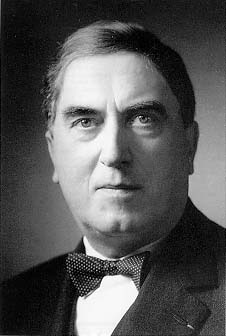
Musical characteristics
Duruflé’s music merges a restrained, classical sense of form with a harmonic language that often recalls impressionist colors and modal sonorities. He drew strong inspiration from Gregorian chant, using chant fragments as thematic material and integrating them into modern textures. His writing is noted for its economy — each chord, voice-leading choice, and registration serves a clear expressive purpose, producing music that feels both ancient and contemporary.
Life and career
Trained in the French organ and choral traditions, Duruflé built a reputation as a skilled performer and accompanist in addition to his composing. He held a long-term church appointment in Paris and toured internationally as an organ recitalist, bringing his interpretive approach to a wide public. His temperament as a perfectionist affected his output: dissatisfied pieces were often withdrawn or destroyed, which shaped the concentrated quality of the body of work that survives.
Major works and repertoire
Though small in number, Duruflé’s surviving pieces are staples in liturgical and concert repertory. Key categories include:
- Choral works and liturgical settings, most notably the Requiem, admired for its fusion of chant and orchestral or organ textures.
- Solo organ music that emphasizes registration, clarity of line, and an austere expressivity.
- Smaller motets and hymn arrangements suited to church use and concert performance.
Reception and legacy
Duruflé is remembered both for his clarity of craft and his devotion to the liturgical and organ traditions. Performers and choirs prize his works for their singable lines, subtle harmonic shading, and careful attention to text setting. His music appears frequently on recordings and in church programs, and he is considered an important mid-20th-century figure who bridged traditional sacred practice and modern harmonic language. For further reading on his life and music consult general reference sources and specialized studies, for example introductions and catalogs at reference sites and recording notes available via publishers and libraries (biographical entry).
Notable facts
- Duruflé’s habit of destroying unsatisfactory pieces contributed to the rarity and careful finish of his published works.
- His use of Gregorian material makes his music a frequent choice for liturgical occasions and commemorations.
- Despite the limited quantity of his output, several of his works enjoy lasting popularity among choirs and organists worldwide.
Questions and answers
Q: Who was Maurice Duruflé?
A: Maurice Duruflé was a French composer and organist born on January 11, 1902, in Louviers and died on June 16, 1986, in Louveciennes.
Q: How did Maurice Duruflé feel about his compositions?
A: Maurice Duruflé was very self-critical of his compositions, and he destroyed many of them that he didn't consider good enough.
Q: What kind of music did Maurice Duruflé write?
A: Maurice Duruflé wrote choral music and music for the organ.
Q: What is the most famous work of Maurice Duruflé?
A: The most famous work of Maurice Duruflé is his Requiem.
Q: Why do we only have a small number of Maurice Duruflé's works?
A: Maurice Duruflé destroyed many of his compositions that he thought were not really good. That is why we only have a small number of his works.
Q: Was Maurice Duruflé only a composer?
A: No, Maurice Duruflé was not only a composer; he was also an organist.
Q: What was the birthplace and date of Maurice Duruflé?
A: The birthplace of Maurice Duruflé was Louviers, and he was born on January 11, 1902.
Author
AlegsaOnline.com Maurice Duruflé — French Composer and Organist Leandro Alegsa
URL: https://en.alegsaonline.com/art/126464