
Kenta Maeda
Kenta Maeda (born April 11, 1988) is a Japanese professional baseball pitcher who rose to prominence with the Hiroshima Toyo Carp, won two Eiji Sawamura Awards and later moved to MLB, noted for command and a sharp splitter.
Overview
Kenta Maeda (born April 11, 1988) is a Japanese professional baseball pitcher who established himself as a leading starter in Nippon Professional Baseball (NPB) before moving to Major League Baseball (MLB). He became widely known in Japan for his control, diverse pitch mix and ability to work deep into games. After a decorated NPB career with the Hiroshima Toyo Carp, he signed with the Los Angeles Dodgers and made the transition to MLB, where he continued to be valued for command and pitch sequencing.
Image gallery
4 Images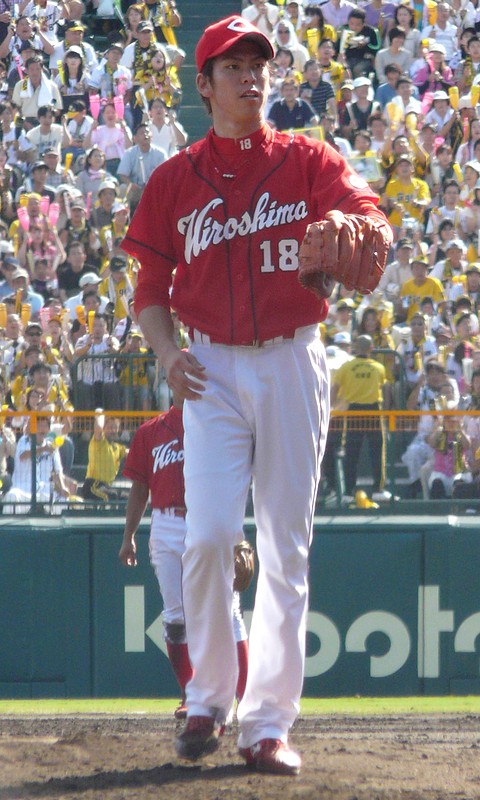


Early career and rise in NPB
Maeda came through the Carp organization and emerged as the team’s ace during his time in Japan. He produced multiple seasons as a reliable top-of-the-rotation starter, noted for low walk rates, the ability to induce ground balls and a splitter used as a finishing pitch. His breakthrough came in the early 2010s when he combined consistency and durability to become one of NPB’s most respected hurlers.
Major honors in Japan
Maeda’s most celebrated seasons included a landmark campaign in which he won the Eiji Sawamura Award and led the league in multiple pitching categories. In that season he posted outstanding traditional metrics for a starting pitcher, including wins, earned run average and strikeouts, earning him the rare distinction of a pitching Triple Crown. He was recognized again with the Sawamura Award later in his NPB career, underscoring his sustained excellence.
Move to Major League Baseball
Following his success in Japan, Maeda signed with the Los Angeles Dodgers and debuted in MLB the season after the agreement. In the United States he was used primarily as a starting pitcher and praised for his ability to mix pitches, change speeds and locate well. He did not rely on overpowering velocity; instead he succeeded by sequencing pitches and exploiting movement and deception to keep hitters off balance.
Pitching style and repertoire
Maeda’s pitching style is built on command, variation and the effective use of a split-finger fastball (splitter). His typical arsenal includes a four-seam and two-seam fastball, a slider, a curveball and a splitter that frequently serves as his putaway pitch. Scouts and analysts have commended his ability to locate all of these offerings, to change eye levels and speeds, and to craft at-bats rather than depending solely on raw velocity.
Legacy and significance
Maeda is part of a generation of Japanese pitchers who successfully transitioned to MLB and helped strengthen the pipeline between NPB and the major leagues. His multiple Sawamura Awards and the rare pitching Triple Crown are key highlights of his legacy in Japan. Beyond awards, he is often cited as an example of how command, a varied repertoire and intelligent game-planning can produce sustained success across different baseball cultures and competitive levels.
Awards and highlights
- Eiji Sawamura Award (two-time winner)
- Pitching Triple Crown in NPB (led league in wins, ERA and strikeouts in a single season)
- Longtime staff ace for the Hiroshima Toyo Carp
Notes on career perspective
Statistics and roles evolve over a long career; Maeda’s strengths—control, pitch mix and durability—allowed him to adapt as teams used him in starting and, at times, relief roles. Observers value his example for pitchers who rely on craft rather than pure velocity, and he remains a frequent reference point in discussions about successful transitions from NPB to MLB.
Questions and answers
Q: Who is Kenta Maeda?
A: Kenta Maeda is a professional baseball pitcher from Japan who plays for the Los Angeles Dodgers in Major League Baseball.
Q: What is Maeda's background in baseball?
A: Maeda previously played for the Hiroshima Toyo Carp in Nippon Professional Baseball in Japan, where he was the youngest pitcher to win the pitching Triple Crown in 2010 and won the Sawamura Award twice.
Q: When was Kenta Maeda born?
A: Kenta Maeda was born on April 11, 1988.
Q: What team does Kenta Maeda currently play for?
A: Kenta Maeda currently plays for the Los Angeles Dodgers in Major League Baseball.
Q: What awards has Kenta Maeda won?
A: Kenta Maeda won the Eiji Sawamura Award in 2010 with a record of 15-8, 2.21 ERA, 174 strikeouts, six complete games, and two shutouts. He won the Sawamura Award again in 2015.
Q: What is the Eiji Sawamura Award?
A: The Eiji Sawamura Award is a prestigious award in Japanese baseball given to the best pitcher in the league each season.
Q: What is the pitching Triple Crown?
A: The pitching Triple Crown refers to a pitcher leading the league in wins, strikeouts, and earned run average (ERA) in the same season, a rare and impressive feat. Kenta Maeda achieved this in 2010, becoming the youngest pitcher in Japanese baseball history to do so.
Related articles
Author
AlegsaOnline.com Kenta Maeda Leandro Alegsa
URL: https://en.alegsaonline.com/art/123583