
479 BC — key events and significance
Year marked by decisive Greek victories against Persia (Plataea and Mycale), the death of Confucius, and the beginning of Ionian liberation; pivotal for Greek ascendancy in the eastern Mediterranean.
479 BC falls near the middle of the 5th century BC and is best known for ending the immediate Persian threat to mainland Greece. It is part of a period when Greek city-states, Persian imperial forces, and emerging intellectual traditions across Eurasia produced events with long-lasting consequences. For broader chronological context see 5th century BC.
Image gallery
1 Image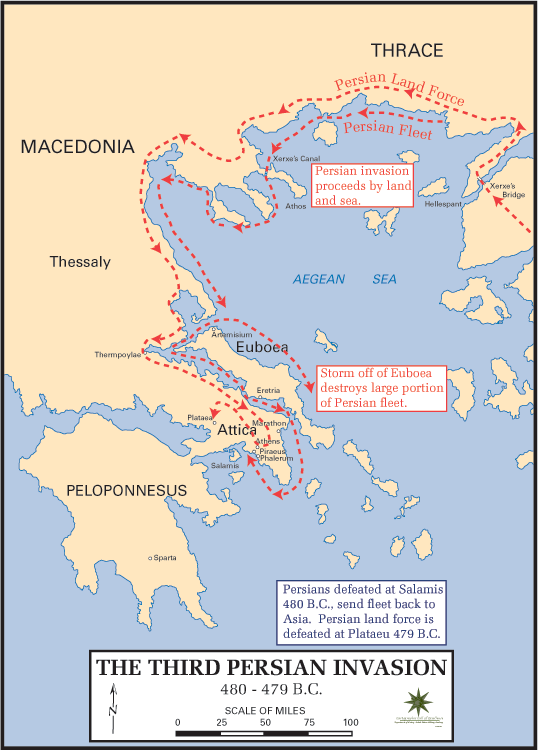
Greco‑Persian conflicts
In 479 BC the allied Greek city-states inflicted two decisive defeats on Persian forces that had invaded Greece. On land, a Greek coalition under Spartan leadership routed the principal Persian army in a battle that resulted in the death of a leading Persian commander and the collapse of Persian ambitions to hold territory in central Greece. At sea, a coordinated Greek fleet won a major action near the coast of Asia Minor, further damaging Persian naval power and enabling Ionian Greek cities to shake off Persian rule.
Consequences and regional effects
The twin victories removed the immediate danger of barbarian conquest for many Greek communities and set conditions for the rise of Athenian influence in the Aegean. Several Ionian cities expelled Persian garrisons and asserted their autonomy. On a military level, the defeats forced Persia to withdraw much of its expeditionary force and to rely on indirect influence rather than large-scale occupation in Greece.
Cultural and political developments elsewhere
In East Asia, 479 BC is traditionally associated with the death of the Chinese philosopher Confucius, whose teachings continued to shape Chinese thought for centuries. In the Italian peninsula and other regions there were ongoing local political and social changes characteristic of early republican and city-state life, though these were less interconnected with the events in the eastern Mediterranean.
Notable figures and legacy
- Leading Greek commanders who directed coalition forces became prominent in contemporary histories and later tradition.
- Key Persian commanders fell in battle or withdrew, weakening Persia's capacity for further immediate invasions of mainland Greece.
- The death of Confucius in this year marks an important moment for the institutionalization of his teachings in subsequent generations.
While 479 BC did not end Persian influence in the Aegean for good, it marked a turning point: the initiative in the eastern Mediterranean increasingly shifted to Greek cities, and the political landscape consolidated in ways that shaped the later classical era.
Related articles
Author
AlegsaOnline.com 479 BC — key events and significance Leandro Alegsa
URL: https://en.alegsaonline.com/art/112912