
Year 477 (AD 477)
AD 477 was a common year of the Julian calendar during late antiquity. This article outlines political conditions across the Eastern Roman Empire, post‑Roman Italy, Britain, and East Asia, and notes cultural trends.
Overview
The year 477 (AD 477) is recorded as a common year in the Julian calendar. It falls in the period often called late antiquity, a time of shifting political boundaries after the collapse of central Roman authority in the West and continuing transformations in the East and in Asia. Chronologies for this period are reconstructed from varied literary, administrative and archaeological sources; for calendar context see the Julian calendar.
Image gallery
1 Image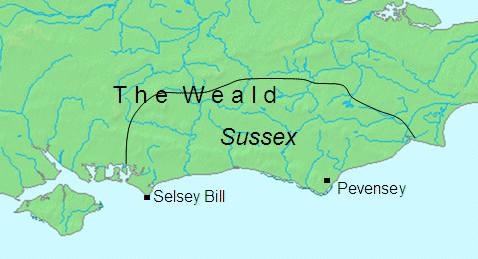
Political landscape
Across Europe and the Mediterranean the legacy of Rome shaped new authorities. In Italy, governance had passed into the hands of Germanic leaders who ruled former imperial territory while maintaining links with the Eastern Roman (Byzantine) court. In the Eastern Roman Empire, imperial institutions continued amid court politics and efforts to manage relations with neighboring peoples.
Regional developments
- Italy and Western provinces: local Germanic kings and warlords administered many former Roman lands, combining Roman administrative practices with new military structures.
- Britain and the northern islands: the late Roman presence had withdrawn and Anglo‑Saxon settlement and local Brittonic polities continued to evolve in this unsettled century.
- East Asia: Chinese northern and southern dynasties pursued state consolidation and cultural programs that would shape medieval institutions.
Religion, society and culture
Religious life remained dynamic. Christianity, increasingly organized and influential, continued to spread and to shape law, education and art. Monasticism and episcopal networks served both spiritual and social functions. Meanwhile, material culture shows continuity in some urban traditions even where political authority had changed.
Significance and research
Year‑by‑year accounts for the 5th century are often fragmentary, so historians combine textual records with archaeology to understand change. AD 477 is representative of a transitional era in which imperial institutions persisted in some regions while new polities and cultural patterns emerged elsewhere.
Further reading
For a general introduction to chronology and the late antique world see standard surveys of late antiquity and primary source compilations that cover the late 5th century.
Related articles
Author
AlegsaOnline.com Year 477 (AD 477) Leandro Alegsa
URL: https://en.alegsaonline.com/art/112911