
3D television (stereoscopic and glasses-free displays)
Comprehensive overview of 3D television: how stereoscopic and autostereoscopic displays create depth, main technologies, history, uses, limitations, standards issues and future prospects.
Overview
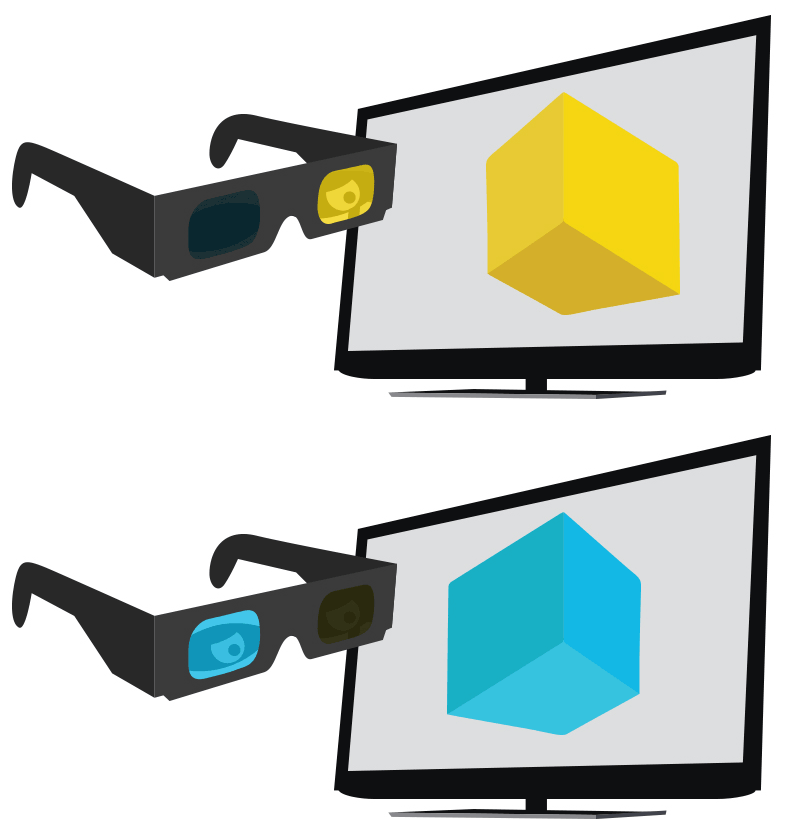
3D television describes display systems and broadcasts that make a flat screen appear to have depth by presenting different images to each eye. The principal perceptual mechanism is binocular disparity: the brain combines two slightly different viewpoints into a single three‑dimensional perception. Implementations range from simple anaglyph filters to consumer stereoscopic sets that require glasses and to glasses‑free autostereoscopic panels.
Image gallery
4 Images


Core technologies
Most 3D approaches deliver two offset images, one intended for the left eye and one for the right. Common methods include:
- Active shutter — battery‑powered glasses alternately block each eye in sync with a display that alternates left/right frames.
- Passive polarized — two images are shown with orthogonal polarization; lightweight polarized glasses direct each image to the appropriate eye.
- Anaglyph — colored filters (for example red/cyan) separate images; inexpensive but degrades color accuracy.
- Autostereoscopic — glasses‑free systems using parallax barriers or lenticular lenses to send different views to different eye positions.
History, adoption and content
Experimental stereoscopic displays have existed for many decades. Consumer 3D TV experienced renewed commercial interest in the late 2000s and early 2010s, driven by studios, broadcasters and electronics manufacturers. Adoption was limited by sparse native 3D content, extra equipment, compatibility and comfort issues, and by the rise of alternative viewing formats.
Uses, limitations and distinctions
Beyond entertainment, stereoscopic displays are valuable in medical imaging, scientific visualization and simulation where depth aids interpretation. Known limitations include reduced perceived brightness, crosstalk (ghosting), restricted comfortable viewing zones for glasses‑free displays and occasional viewer discomfort. 3D TV is distinct from volumetric displays, light‑field systems and holography, which aim to reproduce more complete view‑dependent light information, and from virtual reality, which typically uses head‑mounted displays with head tracking.
For a technical introduction to formats, broadcasting practices and playback standards, see technical overview.
Related articles
Author
AlegsaOnline.com 3D television (stereoscopic and glasses-free displays) Leandro Alegsa
URL: https://en.alegsaonline.com/art/112864