
1470 — Year overview, context and numeric properties
A concise overview of the year 1470: key political events (including the Readeption of Henry VI), broader 15th‑century developments, and mathematical facts about the number 1470.
Overview
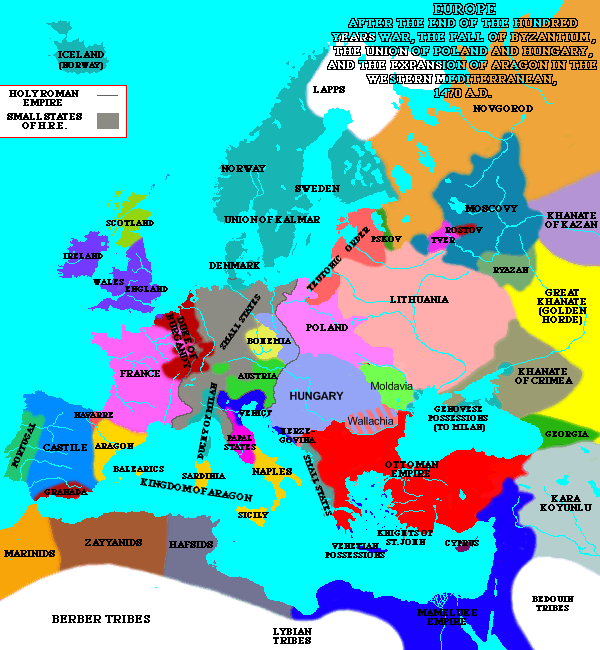
The year 1470 belongs to the late Middle Ages, a period of political turbulence and cultural change in Europe and beyond. In England it is chiefly remembered for a dramatic reversal in the Wars of the Roses: a short-lived restoration of the Lancastrian king Henry VI, an episode often called the Readeption. Across the continent, the Renaissance continued to spread its influence in the arts and learning, while seafaring powers such as Portugal pushed further into Atlantic and African waters, laying groundwork for later global exploration.
Image gallery
3 Images

Political events and significance
Politics in 1470 were shaped by shifting noble alliances and dynastic rivalries. In England, Richard Neville, the Earl of Warwick—known to history as "the Kingmaker"—played a decisive role by turning against King Edward IV and arranging Henry VI's brief return to the throne. Edward IV sought refuge on the Continent, and the episode underscores how fragile royal authority could be when challenged by powerful aristocratic factions. Elsewhere, principalities and states in Italy, Iberia and Eastern Europe experienced comparable contests for influence as centralized monarchies and regional elites negotiated power.
Culture, technology and global context
The mid‑15th century was a time of accelerating change. Movable type printing, introduced a few decades earlier, had by 1470 spread to many European cities, increasing the availability of books and fostering literacy among urban elites. Artists and scholars drew on classical models while developing local styles that characterize the Renaissance. Maritime exploration and commercial expansion by Portuguese sailors were creating new contact zones along the African coast; these developments would later reshape trade and cross‑cultural encounters in the Atlantic and Indian Oceans.
Mathematical and lexical notes on 1470
As an integer, 1470 has several elementary mathematical properties of note: its prime factorization is 2 × 3 × 5 × 7². It has 24 positive divisors, and the sum of its proper divisors exceeds the number itself, so 1470 is classified as an abundant number. In Roman numerals 1470 is written MCDLXX. These features are routine but useful for number‑theoretic classification and notation.
Contextual importance and distinctions
Although no single global event of 1470 matches the scale of later turning points, the year exemplifies patterns that define the late 15th century: fragile dynastic rule in parts of Europe, the spread of print culture, and expanding maritime activity. For England the Readeption is a focal incident within the longer Wars of the Roses; for broader history the decade illustrates how political instability and technological change often coexisted and sometimes reinforced each other.
Related articles
Author
AlegsaOnline.com 1470 — Year overview, context and numeric properties Leandro Alegsa
URL: https://en.alegsaonline.com/art/111387