
1325 (number and year)
1325 is an integer and the label of a year in the 14th century. This entry summarizes its arithmetic properties, common representations, and the most widely cited historical contexts associated with AD 1325.
Overview
1325 functions both as a mathematical integer and as a calendar year in the early 14th century. In mathematics it is studied by its divisors, factorizations and representations in different numeral systems. As a year, AD 1325 is commonly noted in general histories for the traditional founding date of Tenochtitlan in central Mexico and for its place within the political and religious landscape of late medieval Europe.
Image gallery
1 Image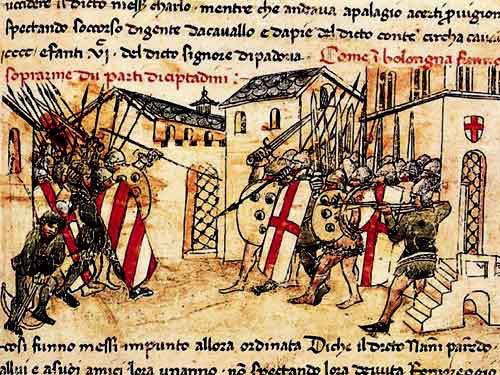
Mathematical properties and representations
As an integer, 1325 is odd and composite. Its prime factorization is 5^2 × 53, so its positive divisors are 1, 5, 25, 53, 265 and 1325. The sum of its proper divisors is 349, which is less than 1325, classifying it as a deficient number. It is not a perfect square (36^2=1296, 37^2=1369), nor a prime.
Because 53 is a prime congruent to 1 modulo 4 and 25 is a square, 1325 can be expressed as a sum of two squares: 1325 = 35^2 + 10^2. Common numeral representations include Roman numeral MCCCXXV, binary 10100101101, and hexadecimal 52D. Its digits sum to 11, a property sometimes cited in simple checksum heuristics.
1325 as a calendar year (AD)
AD 1325 lies in the Late Middle Ages. In Mesoamerican tradition this year is widely given as the founding date of Tenochtitlan by the Mexica (later known as the Aztecs) on an island in Lake Texcoco; that foundation is a central origin story for the later city-state that became the Aztec capital. In Europe the period is marked by the Avignon Papacy, shifting dynastic politics, localized warfare and continuing social and economic change that characterized the early 14th century.
Contexts and cultural uses
- Pre-Columbian Americas: The traditional date for the establishment of a settlement that became Tenochtitlan is often cited as 1325 and is a focal point in Mesoamerican chronologies and national histories of Mexico.
- European backdrop: 1325 predates larger conflicts and political realignments later in the century; it sits within a phase of papal influence and regional rivalries in Europe.
- As an identifier: The number 1325 is used in cataloguing, model numbers, street addresses and product codes; in these contexts it serves as an arbitrary label with no special mathematical meaning.
Remarks and summary
1325 is a modestly interesting integer from elementary number theory because of its square factor and representation as a sum of two squares. As a historical year it is mainly remembered for traditional and symbolic dates such as the founding associated with Tenochtitlan and for its placement within broader medieval developments. The entry therefore combines concise arithmetic facts with high-level historical context rather than exhaustive coverage of every event recorded in that year.
Related articles
Author
AlegsaOnline.com 1325 (number and year) Leandro Alegsa
URL: https://en.alegsaonline.com/art/111253