
What a Way to Go!
1964 American romantic comedy musical directed by J. Lee Thompson, starring Shirley MacLaine with a star-studded supporting cast and noted for its satirical, episodic take on wealth and marriage.
What a Way to Go! is a 1964 American romantic comedy musical film directed by J. Lee Thompson. The picture is remembered for its lush production values, an episodic structure that combines comedy and song, and an unusually prominent roster of leading actors assembled in supporting and cameo roles. Shirley MacLaine leads the film, carrying both comic and musical scenes while narrating an ironic tale about fortune, ambition and love.
Image gallery
1 Image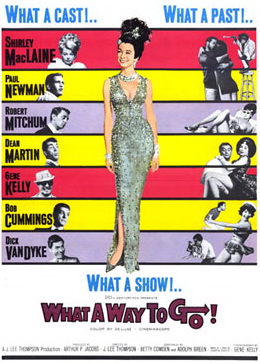
Plot overview
The narrative follows MacLaine's character as she recounts a series of relationships that lead to sudden and often darkly comic outcomes. The structure is largely episodic: each segment pairs her with a different partner or suitor, and each sequence treats themes of money, social aspiration and the unexpected cost of prosperity. That blending of broad comedy with melancholy undercurrents gives the film a tone that alternates between spectacle and satire.
Cast
The film is notable for a lineup of major stars, many appearing in distinct segments rather than as a single ensemble:
- Shirley MacLaine — the central performer who carries the film's emotional and comic core.
- Paul Newman — one of several high-profile male co-stars.
- Robert Mitchum — contributes to the film's mixture of irony and melodrama.
- Dean Martin — appears with his characteristic ease and charm.
- Gene Kelly — brings musical-dance credentials in a notable segment.
- Robert Cummings — part of the varied supporting ensemble.
- Dick Van Dyke — provides comic energy in his appearance.
Production and background
The film's production is often discussed in relation to its casting history: it was originally conceived as a vehicle for Marilyn Monroe, but that plan changed after her death. The revised casting and framing helped make the final picture more of an ensemble showcase, with MacLaine anchoring a series of set pieces and musical numbers. The visual approach emphasizes costume and production design to underline the satire of wealth and display.
Style, music and reception
Musical numbers in the film are staged to enhance both comedy and spectacle; choreography and set decoration are used to underline the ironic commentary on affluence. Contemporary critics were divided: many praised the performances and visual polish, while others found the tone uneven. Over time the film has remained of interest to students of 1960s studio filmmaking, both as an example of star-driven marketing and as a glossy, tongue-in-cheek entertainment that reflects mid‑century attitudes toward money and marriage.
Related articles
Author
AlegsaOnline.com What a Way to Go! Leandro Alegsa
URL: https://en.alegsaonline.com/art/107657