
Turbostar diesel multiple unit family
Turbostar is a family of British diesel multiple-unit trains built at Derby for regional and commuter services; introduced after rail privatisation, it includes Classes 168, 170, 171 and 172.
Overview
The Turbostar name applies to a family of diesel multiple units (DMUs) built in the United Kingdom for regional and commuter rail services. The trains were manufactured at the Litchurch Lane works in Derby by a company that became part of Bombardier Transportation (Bombardier), following earlier activity under the ADtranz name. The Turbostar family became one of the most numerous and widely used modern DMU types in Britain after privatisation, complementing its electric counterpart, the Electrostar (Electrostar).
Image gallery
8 Images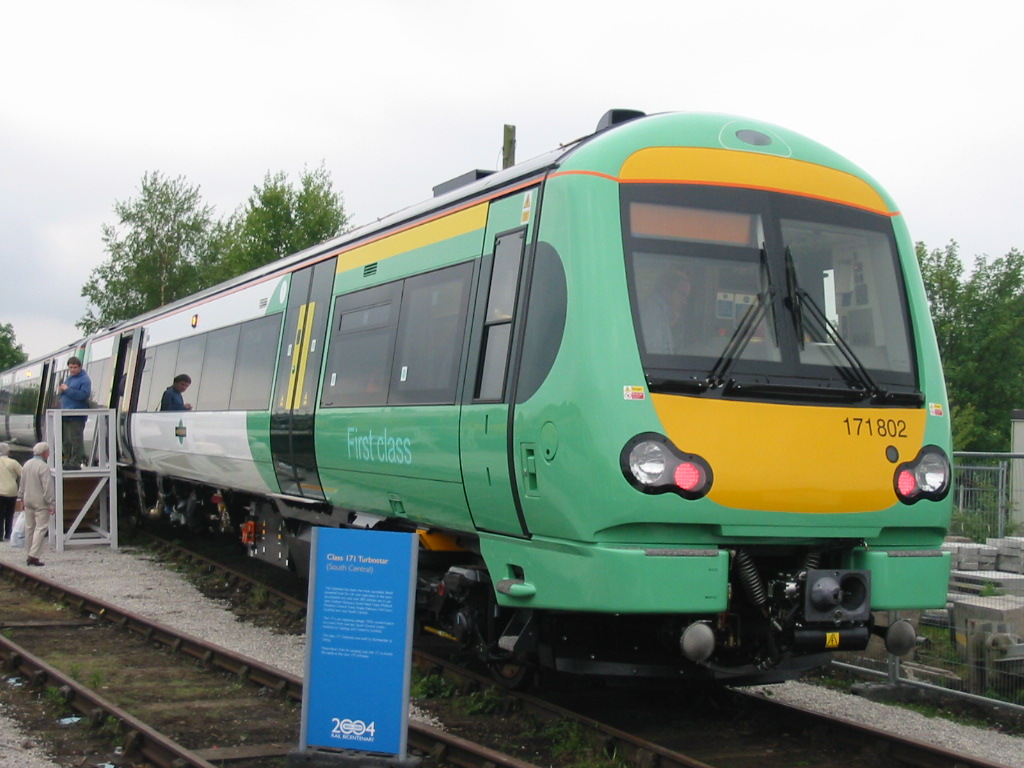


Design and common characteristics
Turbostar trains are modular in concept and were produced in short formations suitable for regional and suburban routes. Sets are typically formed of two, three or four cars, and they share a broadly similar bodyshell and interior layout across subclasses, which simplifies maintenance and operation for train companies. Common design goals included improved passenger comfort compared with older first-generation DMUs, faster acceleration for stop-start services, and easier compatibility with station platforms and signalling systems.
Variants and classes
The Turbostar family expanded into several numbered classes, each adapted for different operators and regional needs. Notable members include:
- Class 168 — the earliest batch ordered by Chiltern Railways (Chiltern Railways) and sometimes known by the marketing name "Clubman."
- Class 170 — a widely used variant that became the backbone of many regional fleets across Britain.
- Class 171 — a version adapted for different coupling and operational requirements on particular routes.
- Class 172 — developed to meet evolving accessibility, noise and emissions standards and to offer refinements over earlier batches.
History and development
The first Turbostar units were ordered in the mid-1990s and entered service in the late 1990s and early 2000s. They were the first completely new train family introduced to the British mainline network after the privatisation of British Rail. Production took place at the Litchurch Lane Works in Derby (Litchurch Lane Works) where a long heritage of rolling-stock manufacture continues in the city of Derby (Derby).
Operators, roles and examples of use
Turbostar units are operated by several train companies and are typically used on regional, inter-urban and longer suburban journeys that require reliable performance without electrification. Their flexibility in formation length makes them suitable for routes with variable demand: shorter peak trains can be strengthened by coupling multiple units together, while single sets serve quieter services. The family’s presence helped modernise services on many corridors previously served by ageing first-generation DMUs.
Notable facts and distinctions
Several points distinguish the Turbostar family within modern British rolling stock. It shares a common lineage with the Electrostar family, which uses the same basic bodyshell and systems philosophy but with electric traction. The numbering into classes reflects differences in equipment, interior fit-out and operator-specific modifications rather than radical changes to the basic design. Over time manufacturers and industry consolidation have changed ownership and support arrangements for the trains, but the Turbostar units remain an important part of the diesel fleet across many parts of the UK rail network.
Related articles
Author
AlegsaOnline.com Turbostar diesel multiple unit family Leandro Alegsa
URL: https://en.alegsaonline.com/art/102063