
Réti Opening (chess)
A hypermodern chess opening beginning with 1.Nf3. The Réti emphasizes piece play and fianchettoed bishops to control the center, is highly flexible and often transposes into other openings.
The Réti Opening is a flexible, hypermodern chess opening that begins with 1.Nf3. Rather than occupying the center with pawns, players who choose the Réti aim to influence central squares from a distance with knights and bishop fianchettos. Its openness and adaptability make it a popular choice at all levels: it can lead to quiet positional battles or to sharp, unbalanced play depending on how both sides develop.
Image gallery
1 Image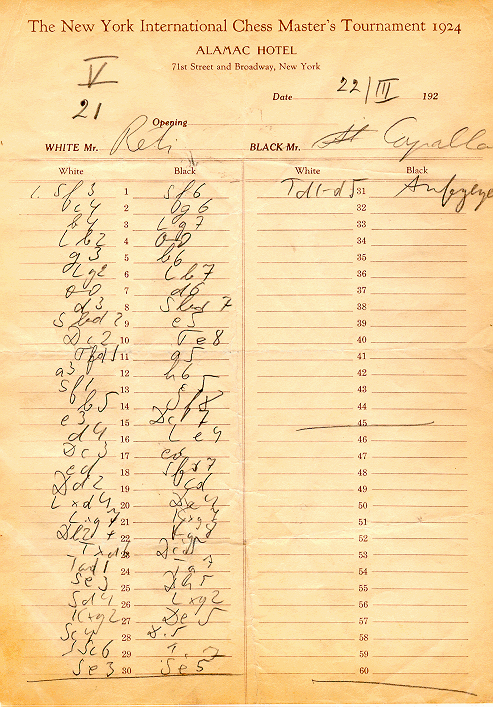
Characteristics and typical moves
Common ideas include developing the kingside knight early, fianchettoing the kingside bishop, and delaying committing central pawns. Typical continuations often feature moves such as 2.g3 and Bg2, accompanied by c4 to pressure the d5 and e4 squares. The Réti often evolves into related systems like the English Opening, the Catalan, or the King’s Indian Attack through transposition.
- Primary initial move: 1.Nf3
- Frequent setup: g3, Bg2, c4, and often Nc3 or d4 later
- Strategic goal: control and undermine the center with pieces rather than pawns
- Flexibility: easily transposes to many mainstream openings
History and influence
The opening is named after Richard Réti, a prominent Czechoslovak grandmaster and theoretician of the early 20th century, and it became a flagship example of the hypermodern approach to chess. Réti and his contemporaries argued that central pawn occupation could be challenged by indirect pressure and dynamic piece play. Over time the opening has been refined and used by many strong players as a way to avoid heavily analyzed main lines while retaining full strategic richness.
Transpositions and practical considerations
One of the Réti’s defining features is its capacity to transpose. After 1.Nf3 players may reach positions that resemble the English Opening, the Catalan, or different queen’s pawn structures depending on Black’s responses. This makes knowledge of typical pawn breaks (for example e4 or d4) and piece maneuvers more important than memorizing exact move orders. The opening rewards understanding of hypermodern themes—targeting an apparently broad center and waiting for the right moment to strike.
For study and practice, consult standard opening manuals and databases to explore common lines, illustrative games, and model plans; many resources labeled as general opening theory include extensive material on Réti setups and transpositional possibilities. Players who prefer flexible, positional play with opportunities for creative maneuvering often find the Réti a satisfying choice.
Author
AlegsaOnline.com Réti Opening (chess) Leandro Alegsa
URL: https://en.alegsaonline.com/art/82341