
Pork Chop Hill (1959 film)
A 1959 American Korean War drama directed by Lewis Milestone, based on S.L.A. Marshall's book, noted for its ensemble cast led by Gregory Peck and its depiction of small-unit combat.
Overview
Pork Chop Hill is a 1959 American war drama directed by Lewis Milestone and adapted from a 1956 book by military historian S.L.A. Marshall. The film dramatizes the tactical and human complexities of close, contested ground fighting during the Korean War. Released by United Artists, it brought together an ensemble cast and emphasized the pressure on junior officers and enlisted men ordered to hold or retake isolated outposts.
Image gallery
1 Image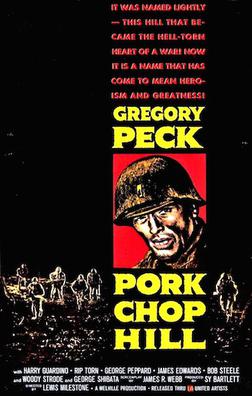
Cast and principal contributors
The motion picture stars Gregory Peck in the lead role and features notable performances by Rip Torn, George Peppard, Martin Landau, and supporting appearances by Abel Fernandez, Biff Elliot, Harry Dean Stanton, Woody Strode and George Shibata. Director Lewis Milestone, already known for earlier war films, guided an ensemble approach that balanced individual character moments with large-scale combat sequences.
Historical basis and themes
The title refers to a real fight fought during the Korean War over a strategically named ridge. While the film compresses events and dramatizes personal conflicts for storytelling, it focuses on themes familiar to war cinema: command responsibility, the cost of orders on ordinary soldiers, the fog of war, and the tactical value — and human toll — of holding terrain with high symbolic or strategic importance. The screenplay draws on Marshall's reporting and interviews to create a portrayal that aims for gritty immediacy rather than grand strategic overview.
Production and style
Produced in the late 1950s, the film adopts a restrained, realistic tone compared with some contemporaneous studio epics. It relies on close-quarters combat staging, ensemble acting, and terse dialogue to convey stress and exhaustion. Critics and viewers often noted the film's emphasis on the soldier's perspective and its focus on small-unit leadership decisions rather than sweeping battlefield spectacle.
Reception and legacy
Contemporary reviews praised several individual performances and the battle staging while offering mixed views on pacing and historical compression. Commercially, it was a modest success rather than a blockbuster. Over time the picture has been discussed for its early attempt to present the moral ambiguities of mid-20th-century limited war and for assembling a cast that included many actors who later became prominent.
Why the film remains notable
- It translates a well-known military account into dramatized cinema without turning the story into a partisan or propagandistic statement.
- It features an ensemble of actors, several of whom went on to long careers in film and television.
- Its focus on leadership under pressure and the human costs of tactical orders gives it continuing value for viewers interested in military history and film portrayals of combat.
For further reading on the film’s production, cast interviews, and historical background, see published film histories and collections of Korean War studies. The film remains a frequent reference point in discussions about how Hollywood depicted the Korean War era.
Gregory Peck | Rip Torn | George Peppard | Martin Landau | Abel Fernandez | Biff Elliot | Harry Dean Stanton | United Artists
Related articles
Author
AlegsaOnline.com Pork Chop Hill (1959 film) Leandro Alegsa
URL: https://en.alegsaonline.com/art/78151
Sources
- nytimes.com : "Pork Chop Hill'; War Drama Directed by Lewis Milestone"
- worldcat.org : 0362-4331