
Look Who's Talking (1989 film)
1989 romantic comedy directed by Amy Heckerling about a single mother, her infant whose inner thoughts are voiced by Bruce Willis, and a taxi driver who becomes involved. It spawned two sequels.
Overview
Look Who's Talking is a 1989 romantic comedy directed by Amy Heckerling. The plot follows a single mother navigating pregnancy, childbirth and the early months of parenthood while forming an unexpected connection with a taxi driver. The film's central conceit is that the newborn's internal monologue is heard by the audience, producing humor that bridges adult romantic comedy and family-oriented situations.
Image gallery
1 Image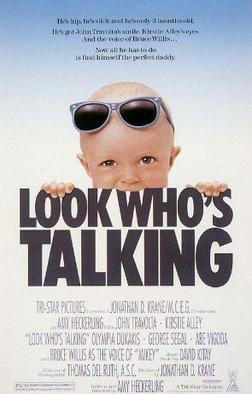
Cast and characters
The movie pairs established screen performers with a distinctive voice performance to create contrast between adult behaviour and an infant's imagined perspective. Principal performers include:
- Kirstie Alley as the mother, Mollie.
- John Travolta as James, the taxi driver who becomes romantically involved with her.
- Bruce Willis as the voice of the baby, Mikey.
Form and comic device
The film relies on voice-over to dramatize the baby's viewpoint, mixing observational and adult-flavored humor with visual gags about everyday parenting. That juxtaposition—an infant with an adult inner voice—serves both as a source of jokes and as a way to comment on dating, single parenthood and family dynamics without becoming heavy-handed.
Production, release and sequels
Released in 1989, the picture performed well with general audiences and quickly became recognizable in popular culture. Its success led to follow-ups that continued the central idea while shifting focus as the franchise developed. Notable sequels include Look Who's Talking Too (1990) and Look Who's Talking Now (1993).
Themes, reception and legacy
Contemporary reviewers offered mixed assessments: many praised the novelty of the gimmick and the charm of the leads, while some critics found the plot conventional. Viewers, however, embraced the film's light tone and star casting. Over time it has been remembered as a late-1980s commercial rom-com that successfully blended adult and family comedy.
Notable facts
Look Who's Talking helped popularize the concept of using a well-known actor to voice an infant's inner life, a tactic later used in other family comedies. Its popularity demonstrated how a simple high-concept joke—an articulate baby—could anchor a mainstream film and spawn a short-lived franchise, while also offering a snapshot of genre blending in that era.
Related articles
Author
AlegsaOnline.com Look Who's Talking (1989 film) Leandro Alegsa
URL: https://en.alegsaonline.com/art/59168