
Kill screen (video games)
A kill screen is an unintentional game state that stops normal play, typically caused by hardware or software limits in older arcade and home-console titles; famous examples include Pac‑Man and Donkey Kong.
Overview
A kill screen is a level or display in a video game that prevents a player from continuing as intended. It is usually an unintended outcome of programming or hardware limits, producing unplayable stages, frozen gameplay, or scrambled visuals. The phenomenon was most common in early arcade and home-console titles where finite memory, limited integer ranges, or timer overflows could not accommodate extremely high level numbers or long play sessions.
Image gallery
9 Images




Causes and characteristics
Kill screens arise from technical limits such as integer overflow, buffer overrun, timer underflow, or missing checks for extreme input values. The result can be a screen filled with junk characters, unreachable objectives, or immediate failure. In some cases the game accepts player input but does not render critical elements; in others the game acts erratically or resets. The garbled output is sometimes described simply as gibberish in community writeups.
Notable examples
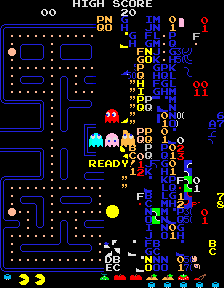
Classic arcade history includes several well-known kill screens. In one famous case, a popular maze game produces a partly corrupted playfield once players reach a very high level: fruit, enemies and other sprites are misdrawn and the right half of the screen becomes unreadable. Another notable example occurs in an early platform arcade title where a level number overflow causes the in-game timer to start at a value so low that the stage is effectively impossible to complete. These examples helped coin and popularize the term.
Importance and cultural impact
Kill screens became milestones for competitive players and preservationists. Reaching a documented kill screen has been treated as proof of endurance and skill in high‑score communities, and recording such events preserves knowledge about original hardware behavior. Emulators, patches and speedrun strategies now allow players to reproduce, avoid or bypass kill screens for study or playability.
Distinctions and modern context
- Unintended vs intentional: Kill screens are generally unintended bugs, distinct from deliberately designed final levels or ending sequences.
- Arcade era prevalence: The phenomenon is associated mainly with early 8‑ and 16‑bit designs constrained by memory and simple arithmetic handling.
- Contemporary handling: Modern games normally include safeguards, input validation and larger numeric types to prevent similar failures.
For an iconic instance often cited in discussions of kill screens, see community descriptions of the original maze game Pac‑Man, and accounts of the platform classic where stage timing breaks at very high levels. Both examples illustrate how hardware and software limits shaped early game behavior and how those limits became part of gaming lore.
Author
AlegsaOnline.com Kill screen (video games) Leandro Alegsa
URL: https://en.alegsaonline.com/art/53385
Sources
- answers.com : answers.com