
Jure Francetić
Jure Francetić (1912–1942) was a prominent Ustaše commander in the Independent State of Croatia, known as leader of the Black Legion and for directing brutal campaigns against Serbs, Jews and Roma during World War II.
Overview
Jure Francetić (3 July 1912 – 27/28 December 1942) was a leading militia commander in the Ustaše regime that ruled the Axis puppet state known as the Independent State of Croatia (Nezavisna Država Hrvatska, NDH) during World War II. He rose to prominence as the organizer and commander of the so-called Black Legion, a Ustaše combat unit active in Bosnia and Herzegovina and surrounding areas. Francetić is widely remembered for his role in campaigns of reprisal, terror and ethnic violence directed primarily against Serb civilians, as well as against Jews and Roma.
Image gallery
2 Images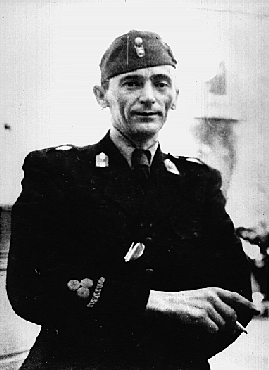

Role and organization
Within the Ustaše movement, which combined Croatian ultranationalism with fascist ideology, Francetić became one of the most visible military figures. The Black Legion began as a mobile, paramilitary formation intended to combat both communist Partisan forces and Serb insurgents, but it also carried out punitive operations that targeted noncombatant populations. He held formal posts within the NDH administration, including a position often described as Ustaše commissioner for parts of Bosnia and Herzegovina, through which he exercised both military and civil authority.
Actions and accusations
Francetić and units under his command were implicated in numerous atrocities during 1941–1942. Contemporary and later accounts describe mass killings, forced expulsions, and other forms of collective punishment of civilians. These actions took place in the context of the broader genocidal policies pursued by the Ustaše state against Serbs, Jews and Roma. Historians and postwar tribunals characterize Francetić's operations as criminal and part of the NDH's program of ethnic persecution.
Death
Francetić was seriously wounded in late 1942 and died soon afterwards when the aircraft evacuating him was lost. Reports give the date of death as 27 or 28 December 1942. His death removed a high-profile Ustaše commander from the field but did not end the violent policies of the regime he served.
Legacy and controversy
The memory of Francetić is deeply divisive. In the aftermath of World War II he was condemned by the victorious anti-fascist authorities and by communities that suffered under Ustaše rule. In later decades, far-right and some nationalist groups in Croatia occasionally sought to rehabilitate or commemorate figures like Francetić, prompting public debate and controversy. For many historians and for the majority of the region's communities, he remains a symbol of Ustaše brutality and wartime crimes.
Notable facts
- Francetić was associated with the Black Legion (Crna Legija), one of the most notorious Ustaše combat formations.
- His activities took place during the Axis occupation of Yugoslavia and the establishment of the NDH, a puppet state of Nazi Germany and Fascist Italy.
- Historical assessments classify his operations as part of the NDH's genocidal and repressive policies against ethnic and political groups.
Understanding Francetić's role provides insight into the dynamics of collaborationist regimes in occupied Europe, the organization of paramilitary violence, and the lasting challenges of memory and accountability after mass atrocities.
Related articles
Author
AlegsaOnline.com Jure Francetić Leandro Alegsa
URL: https://en.alegsaonline.com/art/51722