
Incus (anvil): the middle ear bone
The incus, or anvil, is a small middle-ear bone that transmits sound vibrations between the malleus and stapes. This article covers its form, function, development, and clinical importance.
The incus, commonly called the anvil, is a tiny bone in the middle ear named for its resemblance to an anvil-shaped tool. It is one of three auditory ossicles that form the ossicular chain and play a central role in conducting sound from the eardrum to the inner ear.
Image gallery
5 Images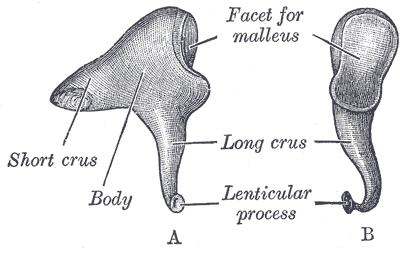



Anatomy and relationships
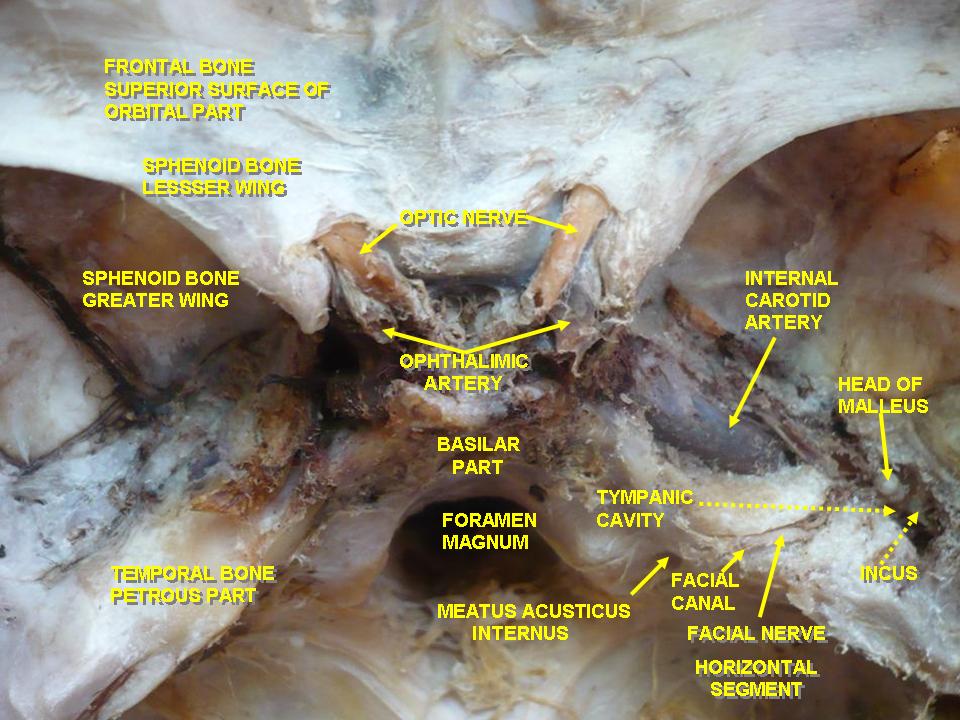
The incus has a compact body with two processes: a short crus that projects backward and a long crus that extends downward. At the tip of the long crus is the lenticular process, a small connection that links the incus to the stapes. The incus articulates with the malleus at the incudomalleolar joint and with the stapes at the incudostapedial joint. It sits in the epitympanic recess of the tympanic cavity and is held by ligaments and mucosal folds.
Function
As part of the ossicular chain, the incus transmits and amplifies vibrations gathered by the tympanic membrane. The arrangement and leverage of the malleus–incus–stapes system increase pressure delivered to the oval window of the inner ear while limiting excessive displacement, enabling efficient transfer of airborne sound into fluid-filled cochlear structures.
Development and evolution
During embryonic development the auditory ossicles form from pharyngeal arch cartilages; the malleus and incus arise from elements associated with the first arch. In evolutionary terms, the incus is homologous to a jaw bone (the quadrate) found in nonmammalian vertebrates—a key transition in mammalian ancestry that repurposed jaw elements into middle-ear bones.
Clinical relevance
Damage or discontinuity of the incus produces conductive hearing loss. Common problems include erosion from chronic otitis media, disruption after temporal bone fracture, or fixation in disease processes. Surgical reconstruction of the ossicular chain (ossiculoplasty) can replace or bypass the incus with prosthetic material to restore sound transmission.
- Key parts: body, short crus, long crus, lenticular process.
- Common issues: ossicular discontinuity, erosion, involvement in middle-ear infections.
- Notable features: small mass and shape optimize high-frequency transmission.
Author
AlegsaOnline.com Incus (anvil): the middle ear bone Leandro Alegsa
URL: https://en.alegsaonline.com/art/47029