
Icosikaitetragon (Icositetragon)
A 24-sided polygon (icosikaitetragon or icositetragon). Definition, regular-case properties, construction, symmetry, formulas and notable examples.
Overview
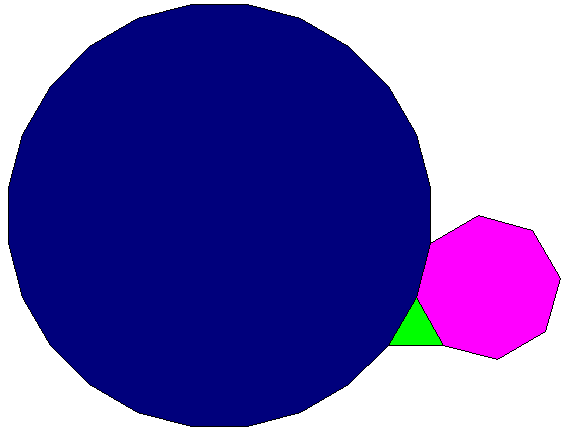
An icosikaitetragon, also called an icositetragon, is a polygon with 24 sides and 24 vertices. The name derives from Greek roots: "icosi-" (twenty) plus "tetra-" (four), often written as icosi+kai+tetragon in older sources. A convex 24-sided polygon has interior angles that sum to (24-2)×180 = 3960 degrees; each interior angle of a regular 24-gon measures 165° and each central angle measures 15°.
Image gallery
5 Images


Key properties
- Number of sides/vertices: 24.
- Sum of interior angles: 3960°; each interior angle (regular): 165°.
- Exterior/central angle (regular): 15°.
- Number of diagonals: n(n−3)/2 = 252.
- Schläfli symbol (regular): {24}.
- Symmetry group (regular): dihedral group D24 of order 48 (24 rotations and 24 reflections).
Formulas and coordinates
A regular 24-gon of side length s has perimeter P = 24s and area A = (24 s^2)/(4 tan(π/24)) = (6 s^2)/tan(π/24). If the polygon is inscribed in a circle of radius R, its area can be written A = (24/2) R^2 sin(2π/24) = 12 R^2 sin(15°). For unit circumradius R = 1 this simplifies to A = 12 sin 15° = 3(√6 − √2), since sin 15° = (√6 − √2)/4. Vertex coordinates for a centered regular 24-gon lie at the 24th roots of unity: e^{2πik/24} for k = 0,…,23.
Construction and regular star forms
The regular 24-gon is constructible with straightedge and compass because 24 = 3·2^3 and 3 is a Fermat prime; equivalently one may construct a 15° central angle by standard constructions (e.g., combine a 60° and a 45° or bisect angles). Beyond the convex form {24}, several regular star polygons can be drawn using the same 24 evenly spaced vertices. Notable regular star forms include {24/5}, {24/7} and {24/11}, which connect every 5th, 7th or 11th vertex in turn to produce star figures.
Uses, examples and distinctions
Large regular polygons such as the 24-gon are often used to approximate circles in engineering, computer graphics and geometric design. They also appear in tiling and decorative motifs where a many-sided form is desired. Do not confuse the planar icosikaitetragon with higher-dimensional objects whose names include 24 (for example, the 24-cell is a four-dimensional regular polytope and is unrelated except by the shared number).
Further reading
For a simple diagram and basic definitions, see a general polygon reference: 24-sided polygon. More advanced discussions treat constructibility, star polygon families, and algebraic expressions for trigonometric values needed to derive exact side and area formulas.
Author
AlegsaOnline.com Icosikaitetragon (Icositetragon) Leandro Alegsa
URL: https://en.alegsaonline.com/art/46494