
Homograph: words spelled the same with different meanings
Homographs are words that share the same spelling but have different meanings; some are pronounced identically, others differ in pronunciation. This article explains types, examples, history, and disambiguation.
Definition and basic characteristics
A homograph is a word that shares its spelling with one or more other words but has a different meaning. Homographs may be pronounced the same way as their counterparts or pronounced differently. When the pronunciation differs, the pair (or group) is often called a heteronym. Homographs can lead to ambiguity in written text because the correct sense must be inferred from context.
Image gallery
1 Image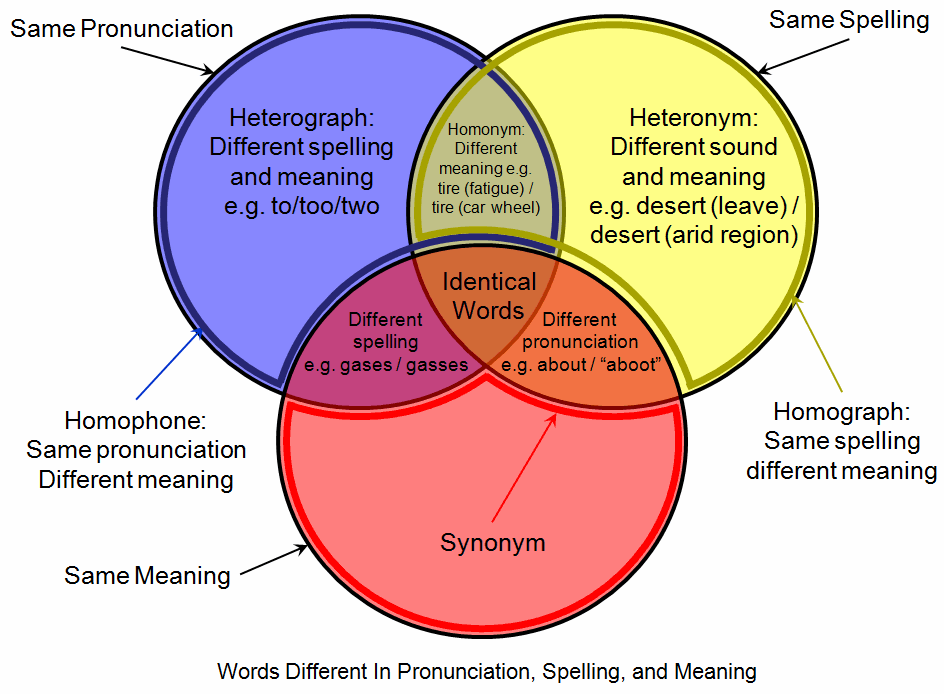
Common types and distinctions
Several related terms are used in language studies and lexicography:
- Homograph: same spelling, different meaning (e.g., "lead" metal vs "lead" to guide).
- Heteronym: a homograph with different pronunciations and meanings (e.g., "wind" /wɪnd/ air vs "wind" /waɪnd/ to turn).
- Homophone: same pronunciation but different spelling or meaning (e.g., "two" and "too").
- Polysemy: a single word with several related senses (closely related to, but distinct from, homography when senses are historically connected).
Examples
English contains many familiar homographs. A short, representative list:
- Polish (from Poland) vs polish (to make shine).
- Dove (the bird) vs dove (past of dive).
- Present (a gift), present (to show), present (to be in a place).
- Lead (/liːd/ to guide; /lɛd/ the metal) and wind (air; to wind a clock).
- Tear (a drop from the eye) vs tear (to rip).
History and usage
Homographs arise for several reasons: historical sound change that altered pronunciation while spelling remained fixed, borrowing of distinct words that converged in spelling, or morphological processes that produce forms with multiple functions. Writers, poets, and humorists often exploit homographs for wordplay and ambiguity. In printing and typography, capitalization can sometimes disambiguate (e.g., "Polish" vs "polish").
Practical importance and disambiguation
Understanding homographs matters in reading comprehension, language teaching, and computational linguistics. Humans disambiguate using sentence context, punctuation, stress, and intonation. Automated systems use part-of-speech tagging and word-sense disambiguation algorithms to assign the appropriate meaning in a given context. Dictionaries typically list homographic senses separately and may mark pronunciation differences. For further reference consult a standard dictionary entry.
Notable facts
Homographs are a source of rich poetic effect and punnery because they allow a single written form to suggest multiple semantic readings. They also illustrate differences between spoken and written language: two words that look identical on the page may be clearly distinct in speech, and vice versa.
Author
AlegsaOnline.com Homograph: words spelled the same with different meanings Leandro Alegsa
URL: https://en.alegsaonline.com/art/44940