
HI — uses, names, abbreviations, and cultural meanings
HI (or Hi/hi) is a short, versatile term: a greeting, a blade feature, a personal name, place name, and a string of abbreviations and codes across chemistry, geography, transport and organizations.
HI (written as HI, Hi or hi) is a brief, widely reused sequence of letters that appears in language, proper names, technical terminology and institutional codes. Because it is short and phonetically simple, it functions as a familiar greeting in English, a transliteration of sounds or names in other languages, the label for physical features (for example on edged weapons), and as an abbreviation or code in many professional and administrative systems. Its precise meaning depends entirely on context.
Image gallery
10 Images


Common uses and everyday meanings
As an English interjection, "hi" is an informal greeting used to attract attention or acknowledge another person. It is equivalent to "hello" in casual speech and writing. In textual and online communication the form "hi" is widespread because of its brevity and neutral tone.
Technical and specialized senses
In arms and metalworking, especially within Japanese sword terminology, a hi (also seen as bo-hi) is a longitudinal groove cut into the blade. Often described as a "fuller" in Western terms, the groove reduces weight while preserving stiffness and balance; it may also influence sound or be decorative. The practice of hollow-grounding or cutting fullers dates back centuries and is found on a variety of edged tools and weapons.
In chemistry the formula "HI" denotes hydrogen iodide, a diatomic molecule composed of hydrogen and iodine. In its aqueous form it is called hydroiodic acid, a strong acid used in organic synthesis and as a reagent. The chemical symbol HI is standardized by chemical nomenclature and is distinct from other alphabetic uses of the same letters.
Codes, abbreviations and institutional uses
The pair of letters "HI" serves as an abbreviation or code in many administrative, commercial and technical contexts. Notable, widely encountered examples include:
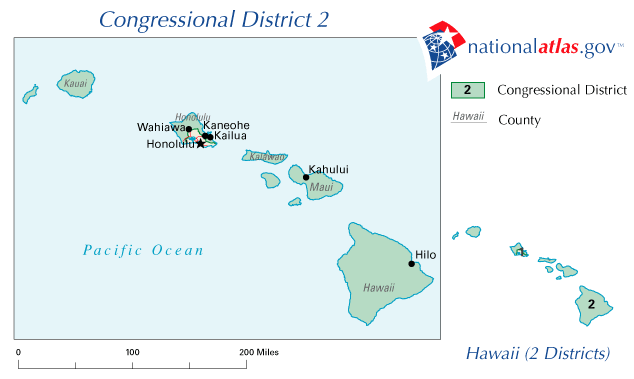
- Postal and geographic codes: HI is the United States postal abbreviation for the state of Hawaii.
- Hospitality and travel: HI commonly denotes Holiday Inn, a prominent hotel brand, and is the initialism for Hostelling International, an umbrella organization for youth hostels.
- Meteorology: "HI" is sometimes used as a shorthand for heat index, a measure that combines air temperature and humidity to express perceived temperature.
- Transport and registration signs: In vehicle registration systems the letters HI are used as a regional marker in some countries; for example, a German licence-plate code corresponds to the district of Hildesheim.
- Organizational and military marks: Certain armed forces and state entities use HI as an identifying abbreviation in national contexts.
Because short letter combinations are economical, many other organizations, businesses and technical fields adopt HI as a compact label; such uses should always be read against local or subject-specific conventions to avoid confusion.
Names, historical occurrences and toponyms
As a proper name, Hi appears across several cultures and periods. Ancient Egyptian records identify multiple artisans and craftsmen called Hi (or transliterations rendered as Hi) who were active in the New Kingdom period and the 18th–19th dynasties; these names are recorded by Egyptologists in publication lists of sculptors, outline draughtsmen and goldsmiths. In modern contexts, Hi can be a family name or personal name in some East Asian usages. Toponymically, Hi names appear at small settlement levels—such as village or hamlet names in parts of Southeast Asia—and as historical province names in older geographical systems.
Language codes and letters
In standards for language identification, the two-letter code "hi" (lowercase) is the ISO 639-1 code for Hindi, the principal standardised register of the Hindustani language used in northern and central India. Alphabetic letter combinations like "HI" may also occur as parts of words, initials or abbreviations in many languages; their interpretation depends on script, orthography and transliteration conventions.
Distinctions, cautions and notable facts
Because "HI" appears in many unrelated domains, it frequently causes ambiguity. Interpreters should rely on surrounding context—field of discussion, capitalization, geographic indicators and subject matter—to determine whether "HI" refers to a chemical compound, a place, a greeting, a brand, a blade feature or a code. When using "HI" as an abbreviation in formal writing, provide a definition on first use to avoid misreading. Finally, short letter pairs like "HI" are often recycled by different organizations and systems, so a single authoritative meaning rarely exists across all disciplines.
In sum, Hi/HI is an example of a succinct signifier whose value comes from convenience and recognizability. Its many applications—from casual salutations to technical chemistry, from blade anatomy to institutional acronyms—illustrate how a minimal sequence of letters can carry diverse meanings across cultures and professions.
Author
AlegsaOnline.com HI — uses, names, abbreviations, and cultural meanings Leandro Alegsa
URL: https://en.alegsaonline.com/art/44020