
Goaria language: a Marwari Rajasthani variety of Sindh, Pakistan
Goaria is an Indo-Aryan (Marwari Rajasthani) variety spoken by a small Hindu community in Sindh, Pakistan. It is a minority, often bilingual, language with oral traditions and regional influences.
Overview
Goaria is a member of the Rajasthani–Marwari group of Indo-Aryan languages. It is spoken by a small community estimated at around 25,000 people in the Sindh region of Pakistan. Speakers identify the variety with Marwari Rajasthani traditions while living within a multilingual environment dominated by Sindhi, Urdu and standard Hindi for liturgical use.
Image gallery
1 Image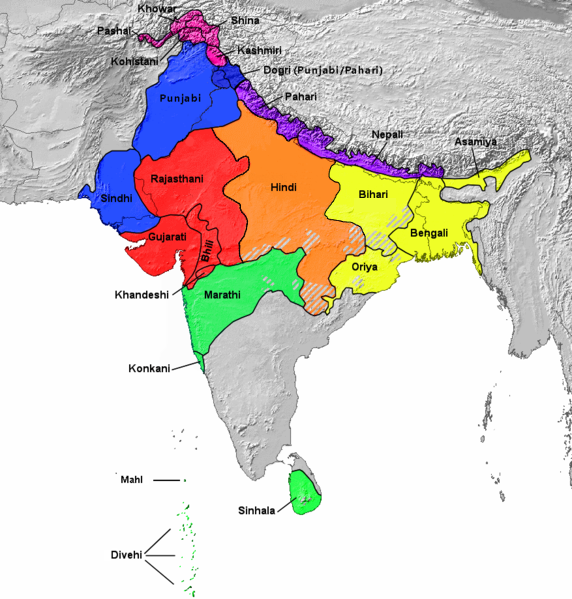
Classification and characteristics
As a Marwari Rajasthani variety, Goaria shares many broad features with related dialects of western India: an Indo-Aryan core lexicon, typical vowel and consonant patterns of the group, and grammatical structures related to other Rajasthani varieties. In everyday use its speech shows influence from neighboring languages through loanwords and code-switching.
- Language family: Indo-Aryan (Rajasthani–Marwari subgroup).
- Typical traits: many shared lexical items with Marwari; phonological and morphological patterns common to Rajasthani dialects.
- Contact effects: borrowing from Sindhi and Urdu in Pakistan.
Geographic distribution and community
Goaria is concentrated in parts of Sindh Province. Many speakers belong to a Hindu minority in Pakistan and maintain cultural practices that connect them to broader Rajasthani heritage. For regional context see Sindh, administrative details in Province descriptions, and national context in Pakistan.
Sociolinguistic role and use
Goaria functions primarily as a community and home language. Members typically use dominant regional languages—Sindhi or Urdu—for wider communication, trade and schooling. The community often uses standard Hindi or its register for religious ceremonies and worship, reflecting cross-border cultural ties with North Indian Hindu practices.
Script, literature and vitality
Like many small regional varieties, Goaria has limited written literature and is mainly transmitted orally. Where writing is needed, community members may adopt the scripts of surrounding languages: Perso-Arabic scripts (used for Sindhi and Urdu) or Devanagari for Hindi-related texts. With a modest speaker base and strong bilingual pressures, Goaria can be vulnerable to language shift unless local transmission and documentation are maintained.
Notable points
Goaria illustrates how Rajasthani varieties extend beyond modern political borders and how language communities preserve identity within multilingual settings. Its study contributes to understanding linguistic diversity in South Asia and the effects of language contact, migration and minority status on small speech communities.
Author
AlegsaOnline.com Goaria language: a Marwari Rajasthani variety of Sindh, Pakistan Leandro Alegsa
URL: https://en.alegsaonline.com/art/39358