
Get Up Stand Up — Bob Marley & The Wailers song
A 1973 reggae protest song by Bob Marley and Peter Tosh from the album Burnin'. Known as a call for rights and resistance, produced by Chris Blackwell and The Wailers.
Overview
"Get Up Stand Up" is a reggae anthem first recorded by Bob Marley & The Wailers and released in 1973 on the album Burnin'. The track, lasting about 3:16, was co‑written by Bob Marley and Peter Tosh and produced by Chris Blackwell alongside the group. It has become widely recognized as a concise, direct appeal for personal dignity and collective action and is often cited among the most influential protest songs in popular music.
Image gallery
1 Image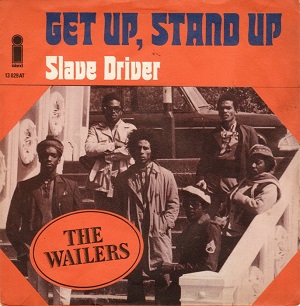
Composition and recording
The song emerged from the Wailers' early 1970s period, when roots reggae rhythms, close harmonies and politically charged lyrics were central to their work. Instrumentation features the characteristic offbeat guitar and organ strokes of reggae, steady bass lines, and call‑and‑response vocals. Production values on the album give the track a warm, live feel while keeping the lyric message prominent.
Themes and message
At its core, "Get Up Stand Up" is a call to resist oppression and insist upon human rights. Its message is succinct and repetitive by design, using straightforward imperatives to urge listeners to act for their own dignity. The song draws on the Rastafari worldview that informed much of the Wailers' material, but its language and concerns—social justice, resistance to exploitation, and personal empowerment—have broad, cross‑cultural resonance.
Reception, legacy and notable uses
Since its release, the song has been adopted as an anthem at political rallies, human rights gatherings and cultural events. It has been performed live by Marley on numerous tours and appears on several live and compilation releases, and it has been covered by a wide range of artists across genres. Critics and fans regard it as one of Bob Marley & The Wailers' most enduring and direct protest songs.
Facts and musical characteristics
- Genre: Reggae, with roots in ska and rocksteady.
- Album: Burnin' (1973).
- Length: approximately 3:16.
- Songwriters: credited to Bob Marley and Peter Tosh.
- Producers: Chris Blackwell and The Wailers.
- Notable features: rhythmic offbeat accents, prominent bass, and a repetitive, exhortatory chorus designed for group participation.
Over decades the song has remained a touchstone in discussions about music and activism, illustrating how concise musical statements can carry lasting political and cultural weight.
Related articles
Author
AlegsaOnline.com Get Up Stand Up — Bob Marley & The Wailers song Leandro Alegsa
URL: https://en.alegsaonline.com/art/38577