
Enneadecagon (19-gon)
An enneadecagon or 19-gon is a polygon with 19 sides and vertices. This article summarizes its geometry, formulas for area and radii, symmetry and star forms, constructibility, and historical naming.
An enneadecagon, commonly called a 19-gon and sometimes named enneakaidecagon or nonadecagon, is a polygon with 19 sides and 19 vertices. The regular enneadecagon has all sides equal and all internal angles equal; it is denoted by the Schläfli symbol {19}. Its central angle (subtended at the center by one side) is 360°/19 ≈ 18.9474° and each interior angle equals 180°(1 - 2/19) = 3060/19 ≈ 161.0526°.
Image gallery
3 Images
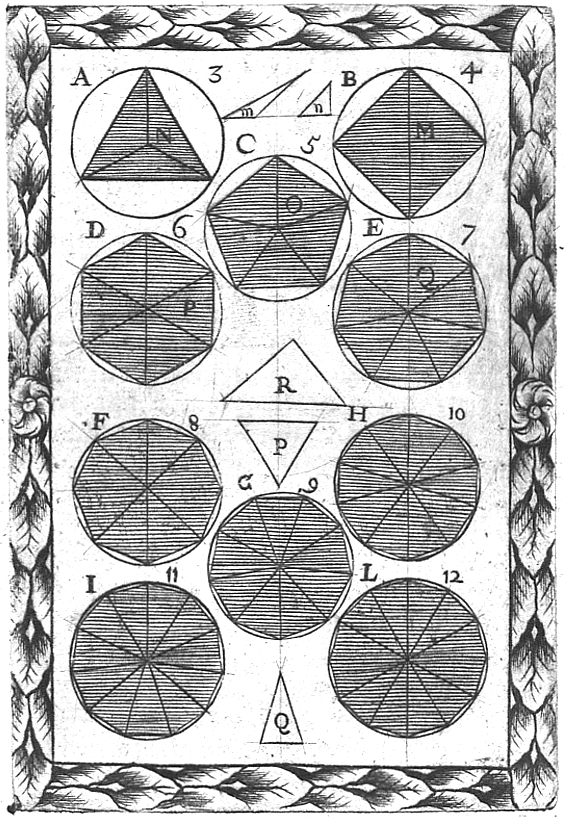
Basic geometric formulas
For a regular enneadecagon with side length s the most used expressions are:
- Perimeter: P = 19s.
- Circumradius: R = s / (2 sin(π/19)).
- Inradius: r = s / (2 tan(π/19)).
- Area: A = (19/4) s^2 cot(π/19), which follows from partitioning into 19 isosceles triangles.
Symmetry and star polygons
The full symmetry group of the regular enneadecagon is the dihedral group D19, of order 38, consisting of 19 rotations and 19 reflections. Because 19 is prime, there are a family of regular star polygons formed by connecting every k-th vertex: the star figures {19/2}, {19/3}, ..., {19/9} (nine distinct nontrivial star polygons) in addition to the convex {19}.
Constructibility and algebraic notes
Unlike polygons with a Fermat-prime factor structure, the regular enneadecagon is not constructible with straightedge and compass because 19 is not a Fermat prime and the cyclotomic extension has degree 18 (not a power of two). Exact coordinates of vertices are expressible using 19th roots of unity, which leads to trigonometric constants such as sin(π/19) and cos(2π/19).
Historically, the Greek-derived names combine ennea (nine), deka (ten) and -gon (angle). The form "nonadecagon" arises from modern Latin/English numbering. Enneadecagons are rare in practical design because of their large number of sides, but they appear in mathematical examples, puzzles, and as motifs in tiling or decorative star patterns.
For diagrams, detailed constructions and numerical tables of trigonometric values related to the 19-gon, see further reading on the regular enneadecagon.
Author
AlegsaOnline.com Enneadecagon (19-gon) Leandro Alegsa
URL: https://en.alegsaonline.com/art/31525
Sources
- books.google.com : Children's Miscellany: Useless Information That's Essential to Know
- books.google.com : Mathematics in the K-8 Classroom and Library
- books.google.com : enneadecagon