
Deadly Blessing (1981 film by Wes Craven)
Deadly Blessing is a 1981 American horror film directed by Wes Craven, starring Ernest Borgnine and an early-career Sharon Stone. A rural folk-horror slasher distributed by United Artists.
Overview
Deadly Blessing is a 1981 American horror film directed by Wes Craven. Combining elements of slasher cinema and folk horror, it centers on escalating violence and mysterious events in an isolated rural community. The movie features veteran actor Ernest Borgnine alongside Maren Jensen, Susan Buckner, and a young Sharon Stone, and was distributed by United Artists.
Image gallery
1 Image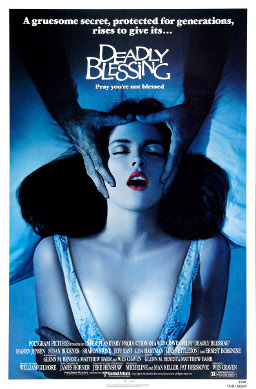
Plot and themes
The story examines tensions between an insular religious group and outsiders who live nearby. Early sequences build atmosphere through uneasy village rituals, suspicious neighbors, and a series of disturbing incidents that blur the line between human malice and possible supernatural influence. The film mixes conventional slasher beats—stalking, sudden violence, and isolation—with broader themes of religious extremism, social suspicion, and psychological dread.
Cast and production
The principal cast includes Ernest Borgnine, Maren Jensen, Susan Buckner, and Sharon Stone in one of her first screen appearances. Production values reflect an early-1980s studio horror approach: on-location shooting, practical effects, and a focus on mood over explicit gore. As with many of its era, the film relied on atmosphere, pacing, and the director's genre experience to generate tension.
Release and reception
Upon release the picture received mixed reviews: some critics praised its mood and thematic ambition, while others found the narrative uneven. It did not become a major mainstream hit but developed interest among genre fans for its unusual combination of rural folk motifs and slasher conventions. Retrospective assessments often place it within the broader context of its director's work and the early 1980s horror landscape.
Notable facts
- Part of Wes Craven's filmography, showing his interest in psychological and social dimensions of horror.
- Blends cult/religious-community antagonists with slasher-style suspense.
- Often cited for its atmospheric production design rather than graphic effects.
Today, Deadly Blessing is referenced in discussions of transitional horror films that bridge 1970s folk-horror and the slasher boom of the 1980s, and it remains of interest to viewers studying the evolution of genre tropes.
Related articles
Author
AlegsaOnline.com Deadly Blessing (1981 film by Wes Craven) Leandro Alegsa
URL: https://en.alegsaonline.com/art/25965