
Dagger
A short, double-edged thrusting blade used historically for close combat, assassination, personal defense, and ceremonial purposes; distinct from single-edged knives and larger swords.
Overview
A dagger is a short knife designed primarily for thrusting and stabbing rather than general cutting. Characteristically it has a double-edged blade that meets at a central point, giving it a symmetrical cross-section suited to penetrating targets. Because of its compact size and pointed tip, the dagger has been used across many cultures where a small, easily carried weapon was desirable.
Image gallery
10 Images
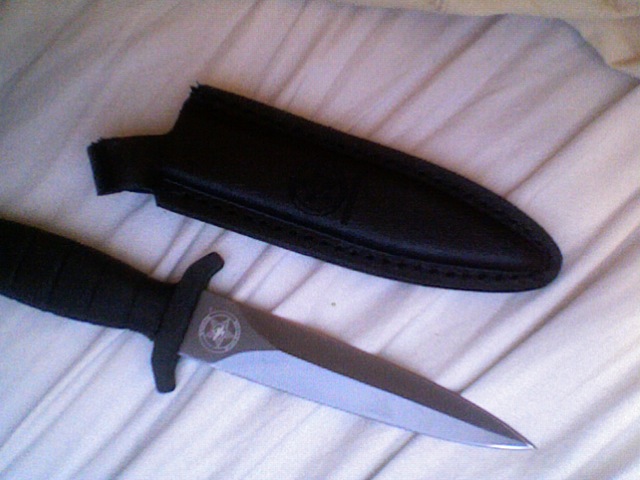


Characteristics and parts
Most daggers share a common set of components: a blade with two sharpened edges; a tang that connects the blade to the handle; a hilt or grip; and often a guard to protect the hand. Materials have varied with technology — from bronze and iron in antiquity to steel in later periods. The balance and construction favor a rigid blade capable of delivering a focused thrust rather than wide cutting strokes.
History and development
Bladed stabbing tools appear early in human history and evolve into the dagger form in many regions. In medieval Europe the dagger served as a sidearm for soldiers and civilians, complementing larger weapons on the battlefield and in personal defense; see the Middle Ages for broader context. During the Renaissance and early modern era specialized forms such as the stiletto and rondel dagger developed to exploit gaps in armor. Daggers have also played roles in politics and crime: for example, the assassination of prominent figures, including Julius Caesar, is often associated with knives of dagger-like form in historical accounts.
Uses and significance
Beyond battlefield use, daggers have been carried for personal protection, used in executions or assassinations, and served as ceremonial or symbolic objects in many cultures. They appear in ritual contexts, as dress accoutrements for military and civic uniforms, and as collectible antiques. In modern times daggers are largely historical or ceremonial; however, some specialized thrusting knives remain in military and law enforcement arsenals.
Types and distinctions
- Stiletto: narrow, pointed; optimized for penetration.
- Rondel dagger: often with a thick, rigid blade for armor penetration.
- Dirk and boot knife: regional or concealment-oriented variants.
Daggers are distinct from general-purpose knives by their double edges and emphasis on the thrust, and from swords by their much smaller size and single-handed use. Legal restrictions and cultural attitudes toward concealed edged weapons vary by jurisdiction and historical period, reflecting the dagger's association with stealthy attack as well as honorable combat.
Author
AlegsaOnline.com Dagger Leandro Alegsa
URL: https://en.alegsaonline.com/art/25076