
Compass rose: purpose, design, history and navigation use
An illustrated guide to the compass rose: map symbol showing directions, its parts and variants, historical development, role in navigation and differences between true, magnetic and grid north.
Overview
A compass rose is a map or chart symbol that indicates directions and bearings. At its simplest it marks the four cardinal points—north, east, south and west—but many roses show additional intermediate points, degree graduations, or decorative motifs. The device helps a map reader or navigator orient the map to real-world bearings and is often labeled or stylized for clarity. For further reading see compass rose.
Image gallery
5 Images


Design and components
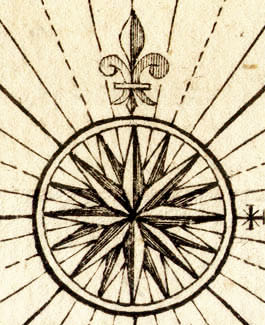
Typical elements include a central pivot or decorative center, points radiating outward, and one or more rings of labels or degree marks. Common configurations are 4-point (cardinal), 8-point (including intercardinal directions such as northeast), 16- and 32-point roses that subdivide the circle into finer bearings. Modern chart roses often show 0–360° degree markings and may include two concentric rings to indicate both true north and magnetic north.
Variations and symbols
- Simple cross: four principal directions.
- Multi-point rose: 8, 16, or 32 named points (e.g., NNE, ENE).
- Degree ring: azimuth or bearing degrees around the circumference.
- Decorative indicators: a fleur-de-lis or arrow commonly indicates north; a Christian cross has appeared historically to mark east.
History and development
The compass rose evolved from earlier windrose diagrams used to show prevailing winds and directions on portolan charts and manuscripts. As magnetic compasses became standard tools for mariners, the rose was adapted to represent magnetic bearings and later to display both magnetic and geographic (true) north. Decorative and symbolic forms became common in the age of exploration, while scientific charts added precise degree scales and declination information.
Uses and practical importance
On nautical and aeronautical charts the compass rose is essential for plotting courses and converting bearings between true and magnetic systems. In land navigation and orienteering a portable compass rose can help correlate a map to local landmarks. Cartographers also use the rose to show grid north used by map projections, and to indicate magnetic variation, the angular difference between magnetic and true north that changes with location and time.
Notable distinctions
Important distinctions include true north (geographic axis of the Earth), magnetic north (direction a magnetic compass points), and grid north (map-projection reference). Many modern roses therefore show two arrows or dual rings and explicitly note the declination and the year or epoch for which the variation applies. Beyond technical use, the compass rose remains a widely recognized design element in logos, architecture and decorative maps.
Related articles
Author
AlegsaOnline.com Compass rose: purpose, design, history and navigation use Leandro Alegsa
URL: https://en.alegsaonline.com/art/22224