
Claudius Aelianus (Aelian): Greek-writing Roman author and compiler
Claudius Aelianus (c.175–c.235 AD), known as Aelian, was a Roman teacher who wrote in Greek. He compiled anecdotal works on animals and miscellanea that preserved earlier texts and shaped natural-history and moral literature.
Claudius Aelianus, usually called Aelian (Greek: Κλαύδιος Αἰλιανός), was a Roman-born author and teacher active in the late second and early third centuries AD (conventionally c.175–c.235). Although a Roman citizen and culturally connected with Latium and Rome, he composed his surviving works in a cultivated Atticizing Greek intended to imitate classical models. He is remembered primarily as a compiler and anecdotal writer rather than as an original philosopher or natural scientist.
Image gallery
3 Images

Major works
Aelian’s two principal surviving works are compilatory and anecdotal in character. They were addressed to literate readers who admired classical Greek diction and sought edifying or entertaining reading.
- De Natura Animalium (On the Nature of Animals) — a multi-book collection of stories, observations and reports about animals. It mixes natural-history notices with marvels, moralizing remarks, and literary citations drawn from earlier authors and oral tradition.
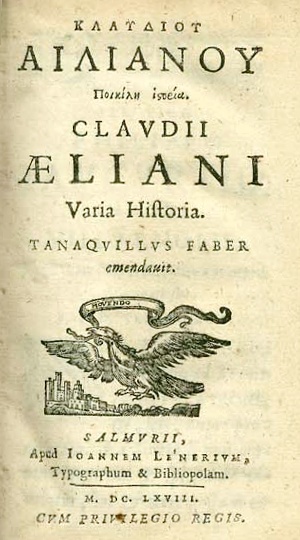
- Varia Historia (Various Histories) — a miscellany of biographical sketches, historical anecdotes, curious facts and ethical examples. The work is arranged as short, self-contained chapters suitable for quotation and classroom use.
Style, sources and purpose
Aelian wrote in an elegant, Atticizing style that deliberately echoed the prose of classical Athens. He gathered material from a wide range of earlier Greek and Roman authors, travellers’ tales and popular lore, often without rigorous critical scrutiny. He sometimes cites authorities but frequently transmits anecdotes on the authority of earlier collections or oral tradition. His purposes appear mixed: to delight and to instruct, to preserve memorable stories and to provide moral exempla. Modern scholars treat his compilations as valuable repositories of lost earlier literature and of popular beliefs, while noting that many reports are anecdotal rather than empirically verified.
Contents and themes
The recurring themes in Aelian’s works include animal behavior and wonder, human character and folly, providence and chance, and ethical exemplars drawn from history and myth. His animal accounts often emphasize extraordinary intelligence, fidelity, or monstrous attributes, and they were influential in the later literary and pictorial tradition of bestiaries. Varia Historia contains brief portraits and stories intended to illustrate virtues, vices and surprising incidents from the ancient world.
Manuscripts, editions and translations
Aelian’s writings have come down to us through medieval manuscripts preserved by the Byzantine manuscript tradition. In the Renaissance his texts were printed and thereafter became available to scholars in Latin and later in various modern languages. Because Aelian quotes or paraphrases many earlier authors whose works are now lost, his compilations are frequently cited by classicists and historians as sources for otherwise unattested material.
Reception and legacy
From late antiquity through the Byzantine period, Aelian was read for entertainment and for the snippets of poetry and prose he preserves. In medieval and early modern Europe his animal anecdotes contributed to the development of bestiaries and to the broader genre of natural-history miscellanies. Today Aelian is valued less for scientific accuracy than for the cultural, literary and historiographical evidence his collections provide: they illuminate Greco-Roman attitudes toward nature, wonder and moral instruction, and they preserve fragments of earlier literature.
How to approach Aelian
Readers should approach Aelian as a compiler and storyteller. His prose rewards attention to style and to the cultural assumptions behind his anecdotes. For historical or biological detail, his reports must be weighed against other evidence, but for the history of ideas, folklore studies and the reception of classical literature his works remain indispensable.
Related articles
Author
AlegsaOnline.com Claudius Aelianus (Aelian): Greek-writing Roman author and compiler Leandro Alegsa
URL: https://en.alegsaonline.com/art/20823