
Z (1969 film)
1969 political thriller directed by Costa-Gavras, adapted from Vassilis Vassilikos's novel. A dramatized investigation of a political assassination, known for its documentary style and international awards.
Overview
Z is a 1969 political thriller directed by Costa-Gavras and adapted from a 1966 novel by Vassillis Vassilikos. The film dramatizes the aftermath of the killing of a reform-minded politician and follows the efforts of a magistrate and others to uncover the truth. Combining fiction with clear references to real events, the film uses a taut narrative and documentary-like techniques to examine state violence, impunity, and civic resistance.
Image gallery
2 Images
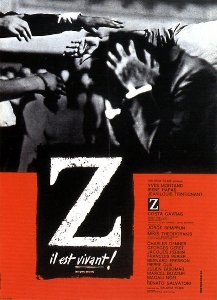
Cast and principal contributors
The picture features an ensemble cast that includes Jean-Louis Trintignant, Yves Montand and Irene Papas, alongside Jacques Perrin, Charles Denner and Bernard Fresson. Costa-Gavras directed, and the screenplay adapted the novel’s themes into a compact, fast-moving film that emphasized procedural investigation as dramatic engine.
Style and structure
Z is notable for blending dramatic storytelling with stylistic elements borrowed from documentary and newsreel footage: hand-held camera work, location shooting, brisk editing and occasional montage. The film maintains a relentless pace while reconstructing events through witness interviews, courtroom scenes and police procedures. Its tone is urgent and accusatory, yet economical in exposition, which helps sustain tension and focus attention on institutional dynamics rather than individual melodrama.
Historical context and inspiration
Although fictionalized, the story was widely understood as responding to political events in Greece during the 1960s, in particular the assassination of a Greek left-wing MP in 1963 and the climate of repression that followed. The film’s title, a single letter, alludes to a Greek slogan meaning "he lives" used by supporters of the slain politician; the choice of a terse emblem underscores the film’s direct political message and its engagement with protest and memory.
Reception and legacy
On release Z drew strong international attention for its political courage and cinematic craft. It was nominated for multiple Academy Awards and won two Oscars, raising the profile of political cinema outside France and Greece. Critics and historians have since regarded Z as a landmark for politically engaged filmmaking: it showed that commercial success and explicit political critique could coexist, and it influenced subsequent films that combine investigative plotting with social commentary.
Notable aspects and continuing relevance
- Blend of fiction and documentary methods that increased the film’s perceived authenticity.
- Use of procedural investigation as a narrative device to explore wider political systems.
- International cast and distribution that helped the film reach audiences beyond its national context.
Today Z is studied both as a finely crafted thriller and as a cultural response to mid-20th-century political violence; it remains widely cited in discussions of cinematic protest, censorship, and the responsibilities of artists in times of political crisis.
Related articles
Author
AlegsaOnline.com Z (1969 film) Leandro Alegsa
URL: https://en.alegsaonline.com/art/148287