
Tigerland (2000 film)
Tigerland is a 2000 American war drama directed by Joel Schumacher, notable for Colin Farrell's breakout role and its portrayal of U.S. Army training before deployment to Vietnam.
Overview
Tigerland is a 2000 American drama film directed by Joel Schumacher. Set in a U.S. Army infantry training camp that prepares soldiers for service in Vietnam, the film focuses on the personal conflicts, moral choices and camaraderie of a small group of recruits. The project is often remembered for giving early prominence to Colin Farrell, whose performance drew attention from critics and audiences.
Image gallery
1 Image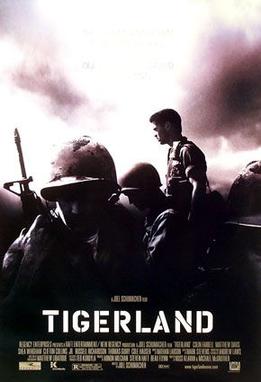
Setting and themes
The action takes place largely in the isolated, intense environment of a training base known informally as "Tigerland." Rather than recreating combat in Vietnam, the film examines the institutional pressures of military preparation: authority vs. individuality, obedience vs. conscience, and the psychological strains of preparing for war. It blends elements of character study, black comedy and moral drama to explore how ordinary young people respond to the demands placed on them.
Cast, style and production notes
The ensemble cast includes a number of actors who later became better known; alongside Farrell appear performers such as Matthew Davis and Shea Whigham, with supporting work from Michael Shannon and others. Joel Schumacher's direction favors close, contained scenes that emphasize dialogue and interpersonal conflict over large-scale action. The film's realistic atmosphere is achieved through concentrated location shooting and a focus on small-group dynamics.
Reception and legacy
Upon release, Tigerland received a mixed-to-positive reception: reviewers frequently praised the cast and the film's gritty tone while noting its modest scale and restrained approach. It did not aim to be a traditional war epic; instead critics often highlighted the performances and the film's interest in the moral questions raised by compulsory military service and combat preparation. For several cast members, Tigerland functioned as an early career showcase.
Notable facts and distinctions
- The title references the training environment rather than Vietnam itself, centering conflict on the moments before deployment.
- The film is often discussed alongside other late-20th-century works that examine the human cost of military systems rather than battlefield spectacle.
- Its compact, dialogue-driven approach makes it a point of reference for viewers interested in character-focused military dramas.
Further information
For those seeking more on the film's production details, cast biographies, or contemporary reviews, consult film databases and critical overviews that catalog early-2000s American cinema and the careers of the principal cast and director.
Author
AlegsaOnline.com Tigerland (2000 film) Leandro Alegsa
URL: https://en.alegsaonline.com/art/146764