
The Front Page (1974 film)
Billy Wilder's 1974 black comedy adaptation of the 1928 play The Front Page, featuring Jack Lemmon, Walter Matthau and an ensemble cast in a satire of tabloid journalism and political spectacle.
The Front Page is a 1974 American black comedy film directed by Billy Wilder. It is based on the 1928 play by Ben Hecht and Charles MacArthur and is commonly described as the third screen adaptation of that stage work. The picture reunites the comic pairing of Jack Lemmon and Walter Matthau with a large supporting ensemble that includes Susan Sarandon, David Wayne, Carol Burnett, Allen Garfield and Charles Durning.
Image gallery
1 Image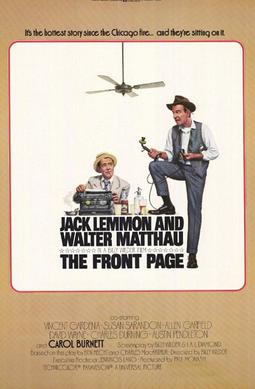
Overview and themes
The story is set in the hectic atmosphere of a newspaper office and revolves around reporters, editors and the political forces that intersect with breaking news. As a black comedy it satirizes the sensationalism of the press, the scramble for headlines, and ethical compromises made in the name of a scoop. The tone mixes rapid-fire dialogue, cynical wit and situational farce to expose how newsrooms and civic institutions can become theatrical arenas.
Cast and production
The film is notable for its ensemble casting and for bringing a stage play back to a cinematic form after earlier screen versions. Principal performers include Jack Lemmon and Walter Matthau, whose on-screen chemistry anchors much of the comic tension. Supporting players such as Susan Sarandon, David Wayne, Carol Burnett, Allen Garfield and Charles Durning contribute to the crowded, noisy feel the story demands.
Adaptation history
The original 1928 play has been adapted several times; earlier notable screen versions include a 1930s film and the well-known 1940 adaptation that altered the central character dynamics. Wilder's 1974 version returned to many elements of the stage structure while translating the material into his own cinematic rhythm. Directors and writers who adapt stage works for film often balance fidelity to the source against changes that exploit camera movement, framing and editing — Wilder's approach leaned toward preserving the fast-moving, ensemble energy of the play.
Reception and legacy
Contemporary reaction to the film mixed appreciation for its cast and Wilder's direction with criticism from some quarters that it did not eclipse earlier adaptations. Over time the movie has been discussed as part of Wilder's later career and as an example of Hollywood's recurring interest in newsroom stories. The film remains of interest for its portrayal of the press as a performative institution and for the performances of a distinguished comedic cast.
Notable facts
- Third major film adaptation of the 1928 play by Ben Hecht and Charles MacArthur.
- Features a prominent pairing of Jack Lemmon and Walter Matthau.
- Includes a broad supporting ensemble with Susan Sarandon, David Wayne, Carol Burnett, Allen Garfield and Charles Durning.
- Often referenced in discussions of films about journalism and media ethics.
Author
AlegsaOnline.com The Front Page (1974 film) Leandro Alegsa
URL: https://en.alegsaonline.com/art/146608