
Annular solar eclipse of June 21, 2020
An annular solar eclipse on June 21, 2020 produced a brief 'ring of fire' visible along a narrow path across parts of Africa, South Asia and East Asia; maximum annularity lasted about 38 seconds.
On June 21, 2020 an annular solar eclipse occurred when the Moon passed between Earth and the Sun but did not completely obscure the solar disk. Observers along a narrow track saw the Sun reduced to a bright ring or "ring of fire," while a much wider region experienced a partial eclipse. The event coincided with the June solstice in the Northern Hemisphere, giving it additional calendar interest.
Image gallery
3 Images
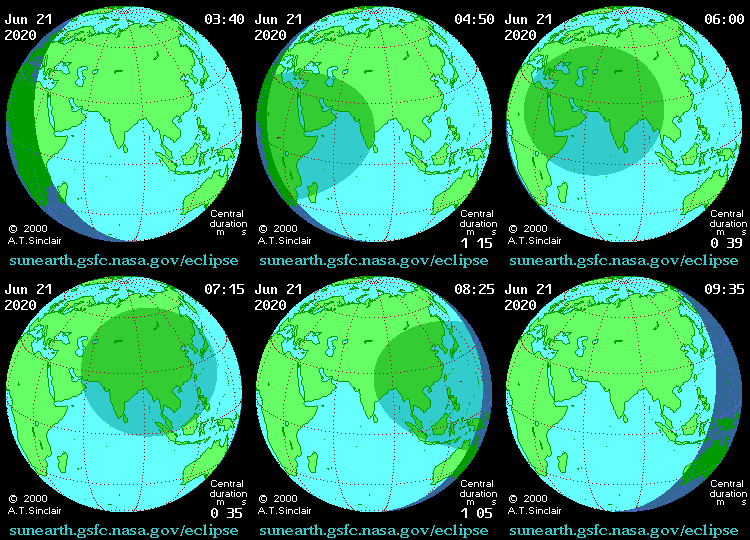

Overview and visibility
The central path of annularity crossed parts of central Africa, the Arabian Peninsula and South Asia before moving into East Asia and the western Pacific. Outside the narrow path, a broad swath of surrounding countries observed a partial eclipse. The maximum interval during which the Sun appeared as a ring was relatively short: annularity at the point of greatest eclipse lasted approximately thirty-eight seconds.
What makes an eclipse annular?
An annular eclipse happens when the Moon is near apogee, its farthest point from Earth in its elliptical orbit, so its apparent diameter is smaller than the Sun's. Because the Moon does not fully cover the solar disk, the outer edge of the Sun remains visible as a bright ring. This distinguishes annular eclipses from total solar eclipses, where the Moon completely hides the Sun for a brief period.
Observation and safety
- Never look directly at the Sun without approved solar filters or eclipse glasses; permanent eye damage can result.
- Use indirect viewing methods such as a pinhole projector or properly filtered telescopes and binoculars.
- During annularity, the bright ring remains unsafe to view without protection—unlike totality, it does not permit naked-eye observation.
Scientific and cultural notes
Solar eclipses, including annular ones, provide opportunities to study solar limb darkening, test instruments, and engage the public in astronomy. They also hold cultural significance in many societies and are occasions for coordinated observations and outreach. For additional details or archival imagery from the 2020 event, see related resources.
Though brief, the annular eclipse of June 21, 2020 was part of the ongoing cycle of solar and lunar motions that produces predictable, repeating eclipse patterns. Its combination of astronomical interest and seasonal timing made it notable both to professional observers and to the general public in the regions where it was visible.
Author
AlegsaOnline.com Annular solar eclipse of June 21, 2020 Leandro Alegsa
URL: https://en.alegsaonline.com/art/145873