
Power (1986 film)
1986 political drama directed by Sidney Lumet about media, money and influence in American politics, notable for an ensemble cast including Richard Gere and Gene Hackman.
Overview
Power is a 1986 American political drama directed by Sidney Lumet. The film examines the interplay of media, money and ambition in contemporary politics through a narrative focused on campaign consultants, lobbyists and politicians. Distributed by 20th Century Fox, it assembles an ensemble cast and approaches the subject with the procedural clarity and moral questioning typical of Lumet's work.
Image gallery
1 Image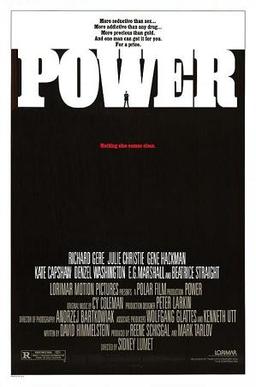
Themes and premise
Rather than a straightforward story about a specific election, the film explores how influence operates behind the scenes: the shaping of public opinion, ethical compromises by operatives, and the tensions between personal ambition and public responsibility. It treats power as a system made up of relationships and communications, highlighting the role of media professionals and strategists who craft images and narratives for political ends.
Principal cast
- Richard Gere
- Gene Hackman
- Julie Christie
- Denzel Washington (in one of his earlier film roles)
- Kate Capshaw
- Beatrice Straight
- E. G. Marshall
- Fritz Weaver
- J. T. Walsh
Production and context
Directed by a filmmaker known for dramas about institutions and moral pressure, the movie was made during a decade of growing public attention to media management and political marketing. The production uses an ensemble approach to dramatize competing interests rather than focusing on a single hero, and it employs realistic detail to depict campaign tactics and newsroom interactions.
Reception and legacy
Upon release the film received mixed reviews: critics often praised performances and Lumet's assured direction while some found the story sprawling or diffuse. It is remembered for its satirical edge and for featuring actors who would remain prominent in later decades. For students of political drama it provides a period view of 1980s media strategies and the ethical questions they raise.
Notable distinctions
Power sits within Sidney Lumet's broader interest in systems of authority and responsibility, alongside films that interrogate law, crime and civic institutions. It is also notable for giving screen time to several actors at different stages of their careers, and for dramatizing the mechanics of influence rather than presenting politics as merely ideological conflict.
See also: discussions of media influence, campaign consulting, and ensemble political dramas for broader context.
Author
AlegsaOnline.com Power (1986 film) Leandro Alegsa
URL: https://en.alegsaonline.com/art/144409