
Missing (1982 film)
Missing is a 1982 political drama directed by Costa-Gavras about an American father searching for his son after the 1973 Chilean coup. It stars Jack Lemmon and Sissy Spacek and won an Academy Award.
Overview
Missing is a 1982 political drama directed by Costa-Gavras. The film follows an American father's determined search for his son in the aftermath of the 1973 Chilean coup d'état. The story blends personal tragedy with a wider inquiry into political responsibility and the role of governments and institutions when a citizen disappears abroad. The film was released by Universal Pictures and features leading performances by Jack Lemmon and Sissy Spacek, supported by Melanie Mayron, John Shea, David Clennon, Jerry Hardin and others.
Image gallery
3 Images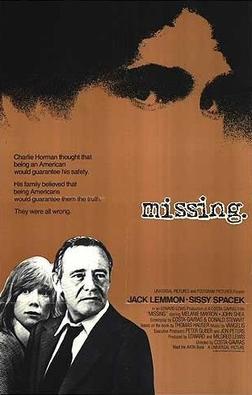

Background and production
Missing is adapted from a book by Thomas Hauser and is based on events surrounding the disappearance of an American journalist during the tumultuous period in Chile. Costa-Gavras, already known for politically engaged cinema, framed the narrative as both a family drama and an investigative procedure, using realistic details and documentary-like touches to heighten authenticity. Production emphasized location atmosphere, the bureaucratic obstacles faced by the protagonists, and the emotional strain of relatives seeking answers in a foreign, politically charged environment.
Plot elements and style
The film centers on the anguish and persistence of the missing man’s parents as they confront local authorities, embassy officials and ambiguous accounts about what happened. Rather than a conventional mystery, the drama unfolds through interviews, official meetings and the slow accumulation of contradictory evidence, exposing institutional failures and the impact of geopolitics on individual lives. Costa-Gavras balances intimate scenes of grief with broader, critical commentary on foreign policy and military intervention.
Reception and awards
Critics praised the film for its performances and moral urgency, especially the work of its lead actors. It received multiple Academy Award nominations and won an Oscar for its adapted screenplay, an acknowledgement of the film’s tightly structured, investigative script. Missing also provoked discussion at the time of its release about historical responsibility and the ethics of state action abroad, making it one of the more debated political films of the early 1980s.
Themes and legacy
The film remains noted for its exploration of human rights, accountability and the limits of diplomatic protection. It is often cited in discussions of political cinema for how it conveys the human consequences of international events and for its unflinching look at institutional reluctance to confront uncomfortable truths. Over time Missing has continued to be studied for both its craft and its subject matter, and it often appears in retrospectives of films that combine personal narrative with political critique.
Principal cast and recognition
- Jack Lemmon — lead performance
- Sissy Spacek — supporting lead
- Melanie Mayron — supporting role
- Jerry Hardin — supporting role
Missing remains a frequently referenced example of cinema that treats recent historical events with a blend of narrative drama and journalistic inquiry. Its awards recognition and ongoing relevance help explain why it is studied by film scholars and continues to be viewed by audiences interested in politically engaged storytelling.
Author
AlegsaOnline.com Missing (1982 film) Leandro Alegsa
URL: https://en.alegsaonline.com/art/142762