
Kiss of Death (1947) — American crime thriller and film-noir landmark
1947 crime thriller directed by Henry Hathaway, based on Eleazar Lipsky's story. Noted for Richard Widmark’s breakthrough performance, noir elements, two Academy Award nominations, and a 1995 remake.
Overview
Kiss of Death is a 1947 American crime thriller directed by Henry Hathaway and adapted from a short story by Eleazar Lipsky. The film blends elements of film noir and courtroom drama to follow a small-time criminal pulled into a larger scheme of betrayal, punishment, and redemption. Released by 20th Century Fox, the picture is best remembered for its tense moral conflicts and an unsettling supporting performance that helped shape the era's portrayals of violent antagonists.
Image gallery
1 Image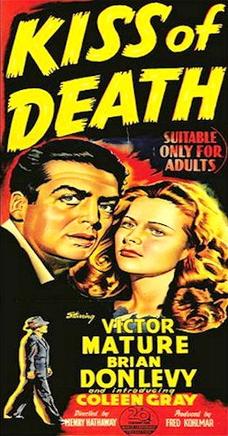
Plot and themes
The narrative centers on a man recently released from prison who tries to go straight but finds himself pressured by crime figures and by law enforcement into dangerous choices. Themes of moral ambiguity, the difficulty of escape from a criminal past, and the cost of cooperation with prosecutors run through the story. The film frequently emphasizes the gritty urban environment and the psychological pressure on its characters, characteristics common to postwar American noir.
Cast and production
The cast includes established and emerging actors of the period: Victor Mature, Brian Donlevy, Coleen Gray, Mildred Dunnock, Richard Widmark and Karl Malden. Widmark’s portrayal of a ruthless henchman was particularly striking and is widely cited as his screen breakthrough. Henry Hathaway’s direction emphasizes tough realism, and Fox promoted the picture as a hard-edged crime drama that would appeal to audiences drawn to suspense and moral complexity.
Reception and legacy
Upon release the film drew attention for its uncompromising scenes and strong performances. It received two Academy Award nominations in 1948, and critics and film historians often single out it for its influence on the depiction of crime and villains in later cinema. A notorious moment involving a violent act against a wheelchair-bound character contributed to the film’s reputation for shock value and remains a cited example of mid‑century on-screen brutality used to define a villain.
Remake and enduring significance
The story was remade in 1995, demonstrating continued interest in its central conflicts of guilt, law, and reform. Today Kiss of Death is discussed in studies of film noir and criminal melodrama for its atmosphere, performances, and its portrayal of the criminal justice system’s pressures on individuals. For readers seeking more detail on casting, production credits, and contemporary reviews see the studio and archive records or specialized film histories.
Further reading
Author
AlegsaOnline.com Kiss of Death (1947) — American crime thriller and film-noir landmark Leandro Alegsa
URL: https://en.alegsaonline.com/art/140958