
Jo Baer — American Minimalist Painter and Artist
Jo Baer (born 1929) is an American painter associated with Minimalism. Known for pared-down forms, emphasis on edges and perception, she showed in New York in the 1960s and had a 1975 Whitney retrospective.
Overview
Jo Baer (born Josephine Gail Baer on August 7, 1929, in Seattle, Washington) is an American painter whose work became identified with the Minimalist developments of the 1960s. She first came to widespread attention in New York in the mid-1960s through exhibitions at galleries that presented contemporary painting, including the Fischbach Gallery. Baer helped to shape debates about the picture plane, surface and the role of the edge in painting, producing deceptively simple compositions that direct attention to how paintings are looked at as much as to what they depict.
Image gallery
6 Images


Early work and methods
Baer’s early, best-known works employ a restrained vocabulary: geometric bands, rectilinear forms, and carefully controlled color fields. Her surfaces are typically flat and even, painted with an economy of gesture that rejects illusionistic depth in favour of perceptual clarity. A recurring concern in these paintings is the relationship between a central area and its surrounding margin; Baer explored how the boundary of the painted area can become a visual focus, creating a tension between figure and ground.
The Stations of the Spectrum and 1960s experiments
Between 1967 and 1969 Baer produced the series titled The Stations of the Spectrum, an extended inquiry into color, surface and perception. Working within a reduced formal language, she experimented with shifting tonal fields and subtle variations in hue. At times she altered previous white grounds to subdued gray, a move intended to change the way color and edge were perceived without resorting to overt pictorial complexity. These works exemplify her interest in how minute changes in tone and boundary affect a viewer’s reading of space.
Major exhibitions and recognition
Baer’s work was shown in prominent commercial and museum venues in New York during the 1960s and 1970s. In 1975 the Whitney Museum of American Art mounted a retrospective of her work, marking an important institutional recognition of her contribution to contemporary painting. The retrospective underlined Baer’s role in the Minimalist moment while also drawing attention to the distinctive questions her paintings pose about perception and the limits of reduction.
Later developments
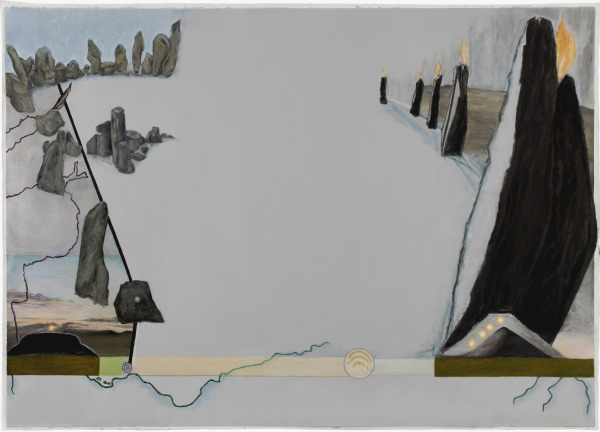
Although she gained recognition through reductive painting, Baer’s practice did not remain static. In later decades she expanded her palette and compositional strategies, moving toward works that reintroduced complexity while retaining an interest in edge, frame and viewing position. Her later paintings and projects show a continued preoccupation with how the act of looking is organized by formal choices, and they reflect an artist who engaged critically with the vocabulary of Minimalism rather than remaining confined by it.
Critical reputation and legacy
Critics and historians often discuss Jo Baer within the context of mid-20th-century Minimalism, but she is also recognized for the particularity of her investigations into peripheral vision and the painted margin. Her work is taught and studied as an example of how reductive means can be used to pose complex perceptual questions. Museums and private collections hold examples of her work, and the 1975 Whitney retrospective remains a touchstone for assessments of her career.
Selected themes and concerns
- Edge and margin: a persistent focus on the boundary between painted surface and surrounding space.
- Surface and tone: careful modulation of flatness and subtle tonal shifts to alter perception.
- Perception and viewing: an interest in how formal minimal elements shape the viewer’s experience.
- Evolution of practice: movement away from strict reduction toward works that reintroduce color and complexity while preserving conceptual rigour.
Jo Baer’s career offers a study in sustained formal inquiry. Her paintings ask simple-looking questions that reward prolonged looking: how a color at the edge can alter a whole composition, how a barely altered tone can shift spatial reading, and how the frame itself participates in meaning. These concerns keep her work relevant for students, practitioners and historians interested in modern and contemporary painting.
Author
AlegsaOnline.com Jo Baer — American Minimalist Painter and Artist Leandro Alegsa
URL: https://en.alegsaonline.com/art/140619
Sources
- diaart.org : Dia Foundation
- tate.org.uk : tate.org.uk