
Goodbye, Mr. Chips — novella and film adaptations
Summary of James Hilton's 'Goodbye, Mr. Chips', its central themes and major screen adaptations, with emphasis on the 1969 musical directed by Herbert Ross starring Peter O'Toole and Petula Clark.
Overview
Goodbye, Mr. Chips began as a short novel by James Hilton that follows the life and career of a gentle schoolmaster at an English boys' public school. Told with restraint and warm nostalgia, the story traces his early years, the influence of war and love on his personality, and his long service to generations of pupils. The original book has been celebrated for its humane portrait of teaching and its quiet emotional power.
Image gallery
1 Image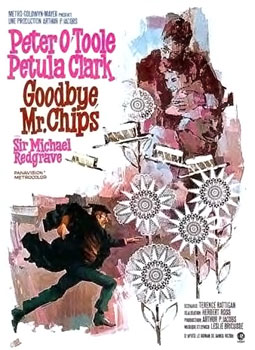
1969 musical film
The story was adapted for the screen several times. A notable take is the 1969 musical film version directed by Herbert Ross. This production recast the lead as a musical role, featuring Peter O'Toole as the titular teacher and Petula Clark in the female lead. Other principal players included Michael Redgrave, Siân Phillips and Alison Leggatt. Released in November 1969, the musical approach divided critics and audiences and is often discussed in relation to earlier, more traditional film versions.
Adaptations and reception
The best-known screen adaptation remains the 1939 film, which brought wide acclaim and awards attention to its star. Later adaptations have returned repeatedly to the source material because of the story's clear, adaptable central character and its episodic structure. The 1969 musical is one of the more ambitious reinterpretations, aiming to translate the novel's intimacy into song and spectacle.
Themes and significance
Across its versions, Goodbye, Mr. Chips explores devotion to teaching, the passage of time, and the small ways a modest life can touch many others. It also reflects social change in Britain across decades and the personal costs of loss and war. Because the protagonist is not a hero in conventional terms, the tale has remained appealing as a study of quiet moral influence.
Further notes
- General film entry — lists cast and production details for the 1969 musical.
- Musical adaptation details — background on the decision to make the 1969 version a musical.
- Peter O'Toole, Petula Clark and other cast links
- For credits and contemporary reviews, see entries associated with Michael Redgrave and Siân Phillips.
Author
AlegsaOnline.com Goodbye, Mr. Chips — novella and film adaptations Leandro Alegsa
URL: https://en.alegsaonline.com/art/138994